


For decades, brand monitoring meant tracking news mentions, social chatter, and search rankings. But in 2026, a new and largely invisible layer has emerged: what AI models like ChatGPT, Gemini, Claude, and Perplexity say about your brand when someone asks. Millions of people now turn to AI assistants for recommendations, comparisons, and reputation checks before they ever open a search engine. If your brand is misrepresented, omitted, or described inaccurately in those answers, you have no idea — unless you're actively monitoring it.
This is the gap that AI brand monitoring fills, and it's quickly becoming a core responsibility for PR and communications teams, not just marketers.
Why This Matters Right Now
A few converging trends make AI brand monitoring urgent:
AI assistants are replacing search for reputation queries. People ask "Is [Company] a trustworthy vendor?" or "What do people think of [Brand]?" directly to ChatGPT instead of Googling it.
LLMs can hallucinate facts about your company. Outdated funding info, incorrect leadership names, or fabricated controversies can appear confidently in AI answers — and spread without your knowledge.
Crisis response windows are shrinking. If a negative narrative gets baked into how AI models describe your brand, it can persist across millions of conversations until the underlying data and sources are corrected.
Competitors are already paying attention. Brands that establish strong, accurate LLM Brand Visibility now will have an outsized advantage as AI-driven discovery grows.

In short: if you're not monitoring how AI talks about you, someone else — a competitor, a journalist, or an unhappy customer — is shaping that narrative for you by default.
What AI Brand Monitoring Actually Involves
AI brand monitoring isn't the same as traditional social listening. It requires a different methodology built around how language models retrieve and generate information.
1. Prompt-Based Tracking
Instead of monitoring keywords, AI brand monitoring tracks how your brand appears across a curated set of realistic prompts — the kinds of questions real customers, journalists, and stakeholders might ask. Examples include:
"What is [Brand] known for?"
"Is [Brand] a reliable company to work with?"
"What are the pros and cons of [Brand]?"
"Who are [Brand]'s main competitors?"
Running these prompts consistently across multiple AI platforms reveals patterns: is your brand mentioned at all? Is the sentiment positive, neutral, or negative? Are the facts accurate?
2. Sentiment and Tone Analysis
Once your brand appears in AI-generated answers, the next question is how it's described. A mention isn't automatically good — being framed as "controversial," "expensive," or "declining" in AI summaries can quietly erode trust at scale. Comprehensive LLM Visibility tracking includes sentiment scoring so PR teams can spot reputational drift before it becomes a full-blown narrative problem.
3. Source and Citation Auditing
LLMs generate answers based on training data and, increasingly, real-time retrieval from the web. That means the articles, reviews, forum threads, and press releases that exist about your brand directly influence what AI says. Auditing which sources are feeding AI answers about your company helps identify:
Outdated or inaccurate third-party content that needs correction
Missing authoritative sources (Wikipedia, industry directories, press coverage)
Negative content that's being amplified through AI retrieval
4. Cross-Platform Comparison
ChatGPT, Gemini, Claude, and Perplexity don't always agree. Each model has different training data, different retrieval behavior, and different update cycles. A brand might be accurately represented in one platform and completely outdated in another. Monitoring across all major platforms — including Claude, which several tracking tools overlook entirely — gives a fuller picture of your actual AI reputation.
A Practical Framework for Getting Started
You don't need an enterprise budget to start AI brand monitoring. Here's a simple framework PR and comms teams can adopt this quarter:
Build a prompt library. Start with 15–20 realistic questions stakeholders might ask about your brand, products, leadership, and reputation.
Run them on a schedule. Weekly or biweekly checks across ChatGPT, Gemini, Claude, and Perplexity establish a baseline and surface changes over time.
Log and score the results. Track whether your brand appears, what sentiment is attached, and whether the facts are accurate.
Identify the source of problems. When something is wrong, trace it back to the underlying content or data source feeding the model.
Fix at the source. Update press pages, correct Wikipedia or directory listings, publish clarifying content, and pursue accurate third-party coverage.
Re-test and track improvement. AI brand monitoring is most valuable as an ongoing loop, not a one-time audit.
Real-World Example: Catching a Reputation Issue Early
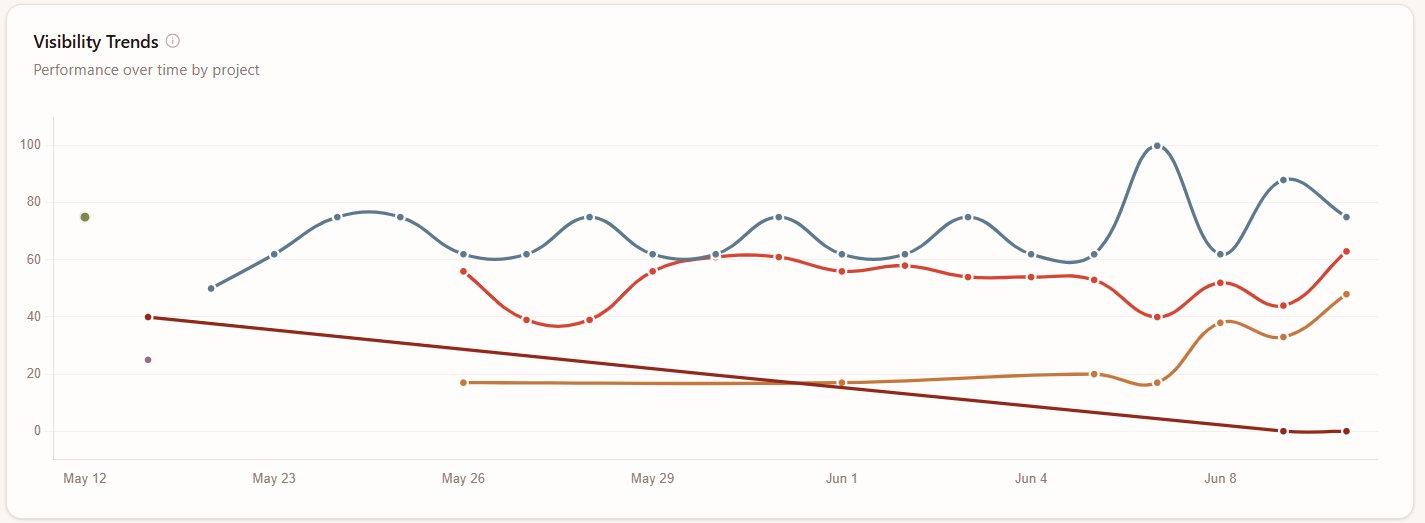
Imagine a mid-sized SaaS company that, six months after a leadership change, asks ChatGPT "Who is the CEO of [Company]?" — and gets the previous CEO's name. That's a small but telling signal: outdated information is circulating in AI answers, and it could extend to far more consequential details like product offerings, pricing, or company values. A team running regular AI brand monitoring would catch this within weeks rather than discovering it during a sensitive moment, like a funding announcement or a journalist's background research.
The Bigger Picture: Monitoring Is the First Step Toward Visibility
AI brand monitoring isn't just a defensive exercise — it's the foundation for a broader AI visibility strategy. Once you understand how your brand currently appears (or doesn't appear) across AI platforms, you can move toward actively improving that presence: strengthening entity authority, optimizing content for AI retrieval, and building the kind of structured, citable information that LLMs prefer to surface.
Brands that treat AI monitoring as seriously as they treat traditional media monitoring will be the ones that control their narrative as AI-driven discovery becomes the default.
Ready to See What AI Says About Your Brand?
You can't manage what you can't measure. If you're ready to find out exactly how ChatGPT, Gemini, Claude, and Perplexity describe your brand — and start fixing the gaps before they become a crisis — it's time to put a real monitoring system in place.
Subscribe to our newsletter for weekly insights, frameworks, and case studies on AI brand monitoring, LLM visibility, and generative engine optimization. Stay ahead of the platforms that are quietly becoming the new front page of the internet.