

Ask ChatGPT to recommend the best tool in your category. Now ask Perplexity, Gemini, and Claude the same question. How often does your brand appear in those answers — and how often does your competitor's? That ratio is your AI Share of Voice, and in 2026 it is quietly becoming the most important competitive metric in marketing. Millions of buying decisions now start (and often end) inside an AI answer, with no list of ten blue links and no second page. If the model names your competitor and not you, you didn't lose the click — you were never in the conversation.
What Is AI Share of Voice?

AI Share of Voice (AI SOV) is the percentage of AI-generated answers in your category that mention your brand, relative to all brand mentions across you and your competitors. It is the AI-search successor to classic share of voice from advertising and the organic SOV metric SEOs pulled from rank trackers.
The formula
AI SOV = (your brand's mentions across a defined prompt set ÷ total brand mentions in that prompt set) × 100
Three parts matter:
Prompt set: a fixed basket of buyer-intent questions your customers actually ask AI assistants ("best X for Y", "X vs Y", "how do I solve Z").
Mentions: every time a brand is named or cited in the generated answer — yours and your competitors'.
Across models: ChatGPT, Perplexity, Gemini, Claude, and Copilot answer differently, so SOV must be measured per platform and blended.
Why AI SOV Matters Right Now
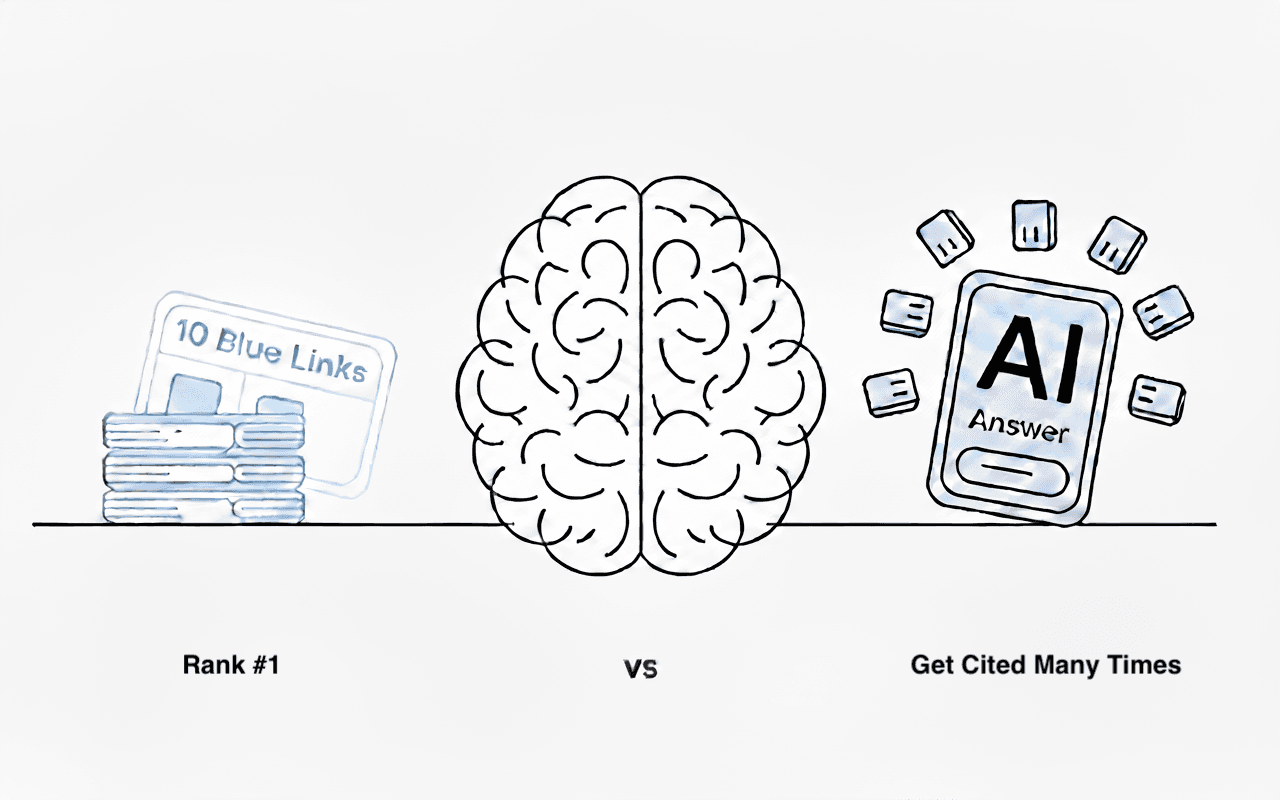
Traditional SEO metrics are losing explanatory power. Zero-click behavior means your rank can hold steady while your traffic falls, because the AI answer absorbed the demand. AI SOV explains what rankings no longer can:
It measures presence in the new front door. A growing share of product research happens inside AI assistants, where there is no position two.
It is inherently competitive. An LLM answer typically names two to four brands. Every mention your competitor earns is a mention you didn't.
It predicts pipeline. Brands that dominate AI answers get referenced in shortlists, RFPs, and buying committees before a single website visit is logged.
It is ownable today. Most categories still have no clear AI-answer leader. The window to define the default recommendation is open — briefly.
How to Measure AI Share of Voice: A 5-Step Framework
1. Build your prompt set
Collect 30–100 questions that map to your funnel: category discovery, comparisons, alternatives, pricing, and problem-based queries. Pull them from sales calls, support tickets, and People Also Ask data.
2. Define the competitive set
List the 5–10 brands that could plausibly appear in your category's answers — including open-source options and legacy players the models love to cite.
3. Query systematically, across models
Run every prompt against each major assistant on a schedule. LLM answers are non-deterministic, so single spot-checks mislead; you need repeated sampling to see the real distribution.
4. Count mentions, citations, and sentiment
Track who gets named, who gets cited as a source, in what order, and with what framing. A mention that says "a popular but dated option" is not the same as "the leading choice."
5. Trend it and tie it to outcomes
Report AI SOV monthly next to branded search volume and AI referral traffic. Doing this manually across models and prompt sets becomes a full-time job — which is exactly the problem an LLM Visibility platform like LLM Search Console solves by automating prompt tracking, mention counting, and share-of-voice dashboards across ChatGPT, Perplexity, Gemini, and Claude.
How to Grow Your AI Share of Voice
Own your entity. Consistent naming, a clear "what we do" definition, schema markup, and a solid Wikipedia/Wikidata footprint make you easy for models to identify and safe to recommend.
Win the sources models trust. Perplexity and Gemini lean on citations. Get included in comparison articles, review sites, G2/Capterra listings, and industry roundups — the pages LLMs ground their answers in.
Publish extractable content. Direct answers, definitions, comparison tables, and FAQs are easy for models to lift. Buried insight is invisible insight.
Close the citation gap. Audit which sources fuel answers where competitors appear and you don't, then earn presence on those exact pages.
Monitor and iterate. Treat LLM Brand Visibility like a rank-tracking program: measure weekly, attribute movements to content changes, and double down on what shifts the numbers.
Common Mistakes to Avoid
Measuring once and calling it done. Answers drift with model updates; SOV is a trend line, not a snapshot.
Tracking only ChatGPT. Your buyers are also on Perplexity, Gemini, and Copilot — and your SOV can differ wildly by platform.
Ignoring sentiment. Being mentioned as the expensive or outdated option can be worse than absence.
Obsessing over "rank" in answers. Position inside an AI answer is volatile; mention rate and share of voice are the durable metrics.
The Bottom Line
Share of voice always predicted market share — the only thing that changed is where the voices are. In AI search, the winner isn't whoever ranks first; it's whoever the model remembers, trusts, and recommends. Define your prompt set, baseline your AI Share of Voice this week, and start closing the gap before your category's default answer hardens around someone else.
Want frameworks like this every week? Subscribe to this newsletter for practical playbooks on AI visibility, generative engine optimization, and tracking your brand across ChatGPT, Perplexity, Gemini, and Claude. And when you're ready to measure your AI Share of Voice automatically, start with LLM Search Console.