

Your best prospect asked Perplexity "which [your category] tool should a 40-person team buy?" and got a five-brand shortlist in eight seconds. You weren't on it. No click, no impression, no trace in your analytics. That is the pain Answer Engine Optimization (AEO) exists to fix. Search engines return links. Answer engines return a verdict. Gartner's projection that traditional search volume drops 25% by 2026 as buyers move to AI assistants is already playing out in the referral reports of most B2B teams, and the gap between brands that appear in AI answers and brands that don't is widening every quarter. This guide covers what AEO is, how it differs from SEO and GEO, and a working playbook you can run this month.
What Is Answer Engine Optimization?
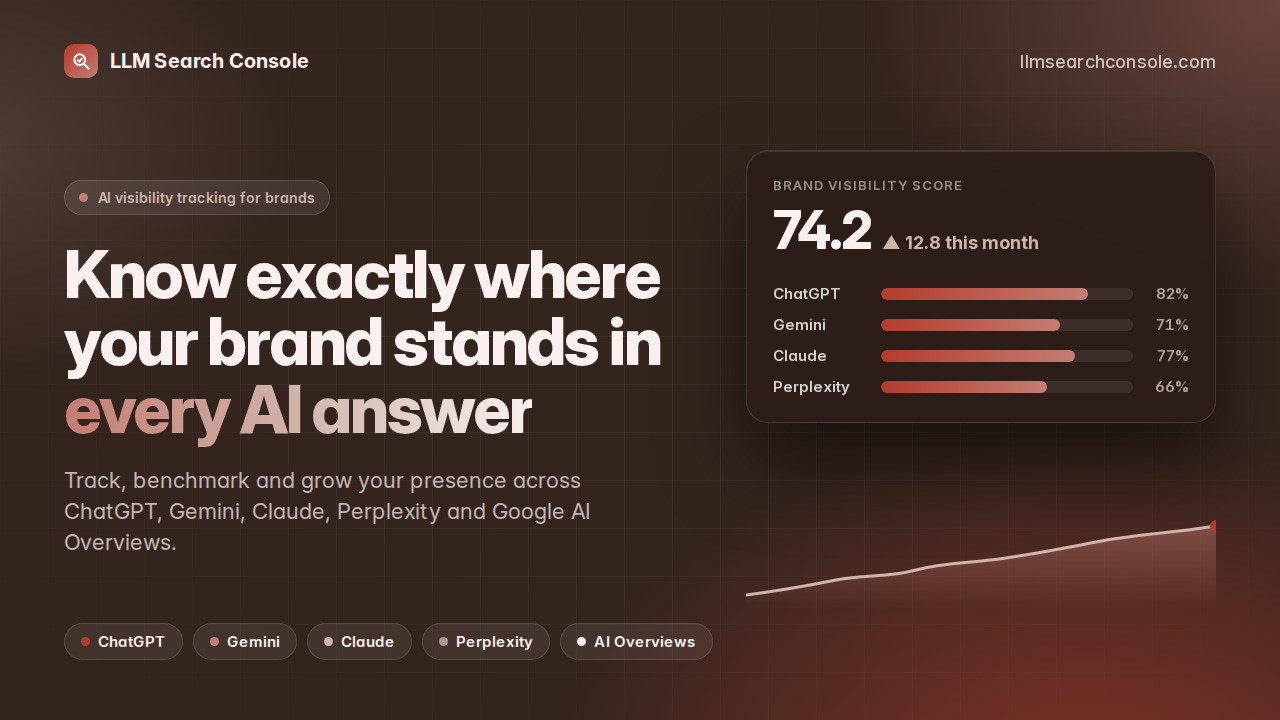
Answer Engine Optimization is the practice of structuring your content, brand signals and third-party footprint so that AI-powered answer engines cite, mention or recommend you when a user asks a relevant question. An answer engine is any system that responds with a synthesized answer instead of a list of links. ChatGPT, Perplexity, Google AI Overviews and AI Mode, Gemini, Claude and Microsoft Copilot all qualify. Voice assistants qualified first, which is where the term originated, but the stakes were low until large language models started handling purchase research.
The unit of success changes. In SEO you win a position. In AEO you win inclusion. There is no page two. A typical AI answer names three to five brands, sometimes one, and everyone else is absent. Measuring that inclusion across the engines your buyers actually use is what LLM Visibility tracking is for.
AEO vs SEO vs GEO
Marketers use these three terms interchangeably, which causes bad strategy. They overlap but optimize for different outputs.
SEO earns a ranked link on a results page. The user still has to click.
GEO (Generative Engine Optimization) shapes how generative models synthesize your content into their output, including citations and source selection.
AEO targets the final answer itself. Are you named, how are you framed, and are you recommended.
In practice GEO and AEO are converging, and most teams treat AEO as the outcome and GEO as part of the method. The distinction that matters for budgeting is this: SEO effort compounds into traffic you can see. AEO effort compounds into mentions you can only see if you measure them deliberately.
Why AEO Matters Now, Not Next Year
Three shifts happened in the last eighteen months that turned AEO from a curiosity into a line item.
First, distribution. ChatGPT passed 800 million weekly users. Google rolled AI Overviews to more than a billion searchers and launched AI Mode as a full answer-first interface. Perplexity crossed hundreds of millions of monthly queries. The buyers you want are already inside these interfaces.
Second, zero-click became the default. Studies from Pew and Ahrefs put click-through drops at 30 to 60 percent for queries that trigger an AI Overview. The traffic isn't moving to a competitor's page. It is disappearing into the answer.
Third, the answer carries endorsement. A user treats "ChatGPT recommended these three" like advice from a knowledgeable colleague, not like an ad. Being named is worth more than a top-three ranking ever was, because the model has already done the comparison for the buyer.
If you sell B2B, you feel this as a specific symptom. Fewer top-of-funnel visits, but inbound leads who arrive with a shortlist already formed. That shortlist was formed in an answer engine. AEO is how you get on it.
How Answer Engines Decide Who Gets Named
You cannot optimize for a black box, so it helps to understand the three inputs that shape an AI answer.
Training data
The model's baseline knowledge of your brand comes from what it learned during training. Wikipedia, major publications, review platforms, forums like Reddit, and your own site all contribute. If your brand barely exists in that corpus, the model has nothing to say about you regardless of how good your product is.
Retrieval
Most answer engines now search the live web before responding. Perplexity always does. ChatGPT does for anything time-sensitive or commercial. Google AI Overviews are built on top of the search index. This means fresh, well-structured pages that directly answer the question still matter, and it is where your SEO investment carries over.
Entity consistency
Models reason about entities, not keywords. If your company name, product names, category, pricing and positioning are described consistently across your site, your Crunchbase and LinkedIn pages, G2 and Capterra listings, press coverage and Wikipedia, the model develops a confident, stable representation of you. Contradictions lower confidence, and low confidence means the model picks a competitor it is surer about.
The AEO Playbook: Seven Moves That Work
1. Start from the prompts, not the keywords
Build a set of 30 to 100 questions your buyers ask answer engines. Not "best CRM" but "which CRM works for a 10-person agency that bills hourly." Pull them from sales calls, support tickets, G2 reviews and the People Also Ask boxes. These prompts become both your content roadmap and your measurement baseline.
2. Measure your baseline before you change anything
Run every prompt across ChatGPT, Perplexity, Gemini and Google AI Mode, several times each, because answers are probabilistic. Record whether you are mentioned, in what position, with what sentiment, and which competitors appear alongside you. Doing this by hand for 50 prompts across four engines takes days. Doing it with an LLM Brand Visibility tracker takes minutes and gives you a trend line instead of a snapshot.
3. Write answer-first pages
Every page targeting a buyer question should state the answer in the first 40 to 60 words, then support it. Models extract the direct answer. They skip the 400-word preamble. Use the question as an H2, answer it in one plain paragraph, then expand. Add a short FAQ section at the end with three to six real questions and tight answers.
4. Publish comparison and "best for" content honestly
Answer engines love structured comparisons because they mirror the answer format. A page titled "[Your product] vs [Competitor]: which fits which team" that admits where the competitor wins will get cited far more than a puff piece. Models are trained to distrust one-sided content and cite balanced sources.
5. Fix your entity footprint
Audit every place your brand is described. Same name, same category, same one-line description, same founding facts. Claim and complete G2, Capterra, Crunchbase, LinkedIn and Product Hunt. Add Organization, Product and FAQ schema to your site. If you qualify for a Wikipedia page, earn one through coverage rather than writing it yourself.
6. Earn third-party mentions in the sources models trust
Reddit threads, industry newsletters, niche review sites, podcasts with transcripts and analyst reports all show up disproportionately in AI citations. A single honest Reddit thread where users recommend you can outweigh ten of your own blog posts. This is PR work, not SEO work, and it belongs in the AEO budget.
7. Track competitors as closely as yourself
AEO is zero-sum. Every answer that names a competitor and not you is a lost consideration slot. Watch which competitors gain share on which prompts, then reverse-engineer the sources the engines cited for them. Those sources are your target list.
A Simple AEO Scorecard
You need three numbers to run this as a program rather than a project.
Mention rate, the share of tracked prompts where you appear at all.
Share of voice, your mentions divided by all tracked brand mentions.
Sentiment and framing, how the model characterizes you when it does name you.
Review them monthly by engine and by prompt cluster. A rising mention rate on informational prompts and a flat one on commercial prompts tells you exactly where to spend next.
Common AEO Mistakes
Treating it as a content-volume game is the biggest one. Fifty thin answer-first pages do less than five authoritative ones plus a consistent entity footprint. The second mistake is measuring once. One run of one prompt in one engine tells you almost nothing, because the same question returns different brands on different days. The third is ignoring sentiment. Being named as "cheaper but limited" is not a win.
Get Your Brand Into the Answer
The buyers who used to find you through ten blue links are now asking a model for a shortlist. Your job is to be on it, consistently, across every engine they use. Start with your prompt set, measure your baseline, fix your entity footprint, and earn the third-party mentions that models trust.
If you want a weekly, practical read on AI search visibility, subscribe to the LLM Search Console newsletter on Substack. One email a week, no filler, only what is working right now for brands trying to win the answer.