

What Is a Brand Visibility Score in AI — and Why Does It Matter More Than Google Rankings?
A few years ago, ranking on page one of Google was the gold standard of brand discoverability. Today, that's no longer enough. Millions of buyers are skipping traditional search entirely and asking AI assistants — ChatGPT, Perplexity, Gemini, Claude — for recommendations, comparisons, and answers. If your brand isn't showing up in those AI-generated responses, you're invisible to a fast-growing segment of your market.
That's where the Brand Visibility Score in AI comes in. It's the emerging metric that tells you, with precision, how often and how favorably your brand appears across AI search engines — and what you can do about it.
In this guide, we'll break down what the Brand Visibility Score is, how it's calculated, why it's becoming a mission-critical KPI, and how tools like LLM Search Console are already measuring it for forward-thinking brands.
What Is a Brand Visibility Score in AI?
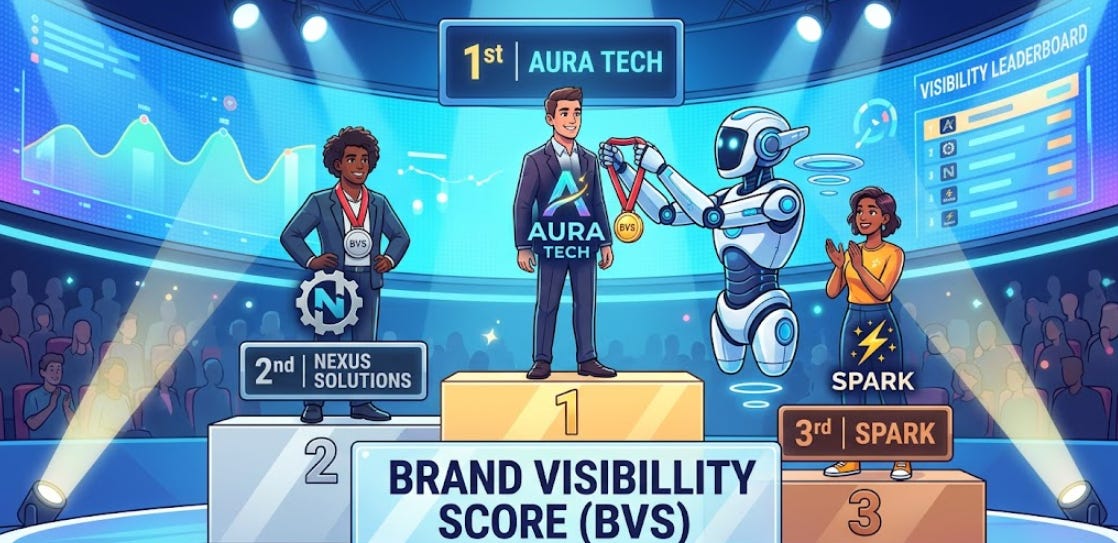
The Brand Visibility Score (BVS) is a composite metric that quantifies how prominently and consistently your brand appears in AI-generated answers across large language models (LLMs). Think of it as your brand's "share of voice" inside AI search engines.
It typically factors in:
Mention Rate: How often your brand is cited when relevant queries are asked
Sentiment: Whether AI responses frame your brand positively, neutrally, or negatively
Ranking Position: Where in the response your brand appears (first mention vs. buried in a list)
Context Accuracy: Whether the AI describes your product or service correctly
Competitive Share: How your visibility compares to key competitors across the same prompts
Unlike a traditional SEO ranking — which is binary (you rank or you don't) — a Brand Visibility Score gives you a nuanced, multi-dimensional view of your presence inside AI answers.
Why Traditional SEO Metrics Miss the AI Search Revolution
Most marketing teams are still optimizing for Google's 10 blue links. But LLM visibility is a fundamentally different game. Here's why your current metrics don't capture it:
AI Answers Don't Have Rankings — They Have Narratives
When someone asks ChatGPT "What's the best CRM for startups?", the model doesn't return a ranked list of URLs. It generates a narrative response — and your brand either appears in that narrative or it doesn't. There's no page two. There's no keyword position. There's a mention, or there's silence.
The Buying Journey Has Shifted
B2B and B2C buyers increasingly use AI to shortlist vendors before ever visiting a website. If your brand doesn't appear in the LLM's response to shortlisting queries, you may never get the chance to compete — even if you rank #1 on Google.
LLMs Have Long Memories (and Long Blind Spots)
AI models are trained on vast corpora of text. If your brand lacks high-quality mentions across authoritative web sources — journalism, reviews, forums, structured data — the model may simply not know you exist, or worse, hallucinate inaccurate descriptions of your product.
How to Calculate a Brand Visibility Score in AI
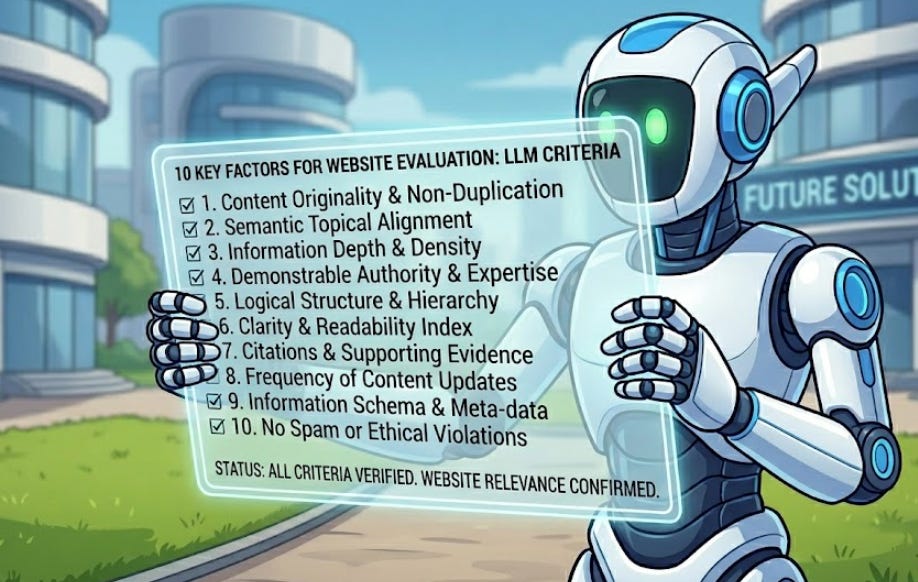
You can think of a Brand Visibility Score as answering one fundamental question: Out of all the relevant AI queries in my category, how often does my brand appear — and in what way?
Step 1: Define Your Prompt Set
Choose 20–100 prompts that represent how your target customers ask AI assistants about your category. Include:
Category queries ("best tools for AI brand monitoring")
Competitor queries ("alternatives to [Competitor X]")
Problem-aware queries ("how do I track my brand in ChatGPT")
Decision-stage queries ("which AI visibility platform should I use")
Step 2: Run Queries Across Multiple LLMs
Your score should reflect performance across ChatGPT, Perplexity, Gemini, Claude, and any other LLMs relevant to your audience. A brand that appears prominently in ChatGPT but is invisible in Perplexity has a partial — and fragile — visibility footprint.
Step 3: Measure Mention Rate, Position, and Sentiment
For each prompt:
Did your brand appear? (Mention Rate)
Where in the response? (Position)
Was the description accurate and positive? (Sentiment + Accuracy)
Step 4: Benchmark Against Competitors
Run the same prompt set for your top 3–5 competitors. Your Brand Visibility Score becomes most actionable when seen relative to your competitive set — not as an abstract number.
Step 5: Track Over Time
LLM outputs shift as models are updated, as new training data is ingested, and as the broader web changes. A one-time snapshot is useful; a weekly or monthly trend is invaluable.
Why Your Brand Visibility Score Is Low (And How to Fix It)
If you run this analysis and find your brand rarely appears in AI-generated answers, there are usually a handful of root causes:
1. Insufficient Digital Footprint
LLMs are trained on the web. If your brand has thin coverage — few third-party mentions, no press, no review-site presence — models simply don't have enough signal to confidently recommend you.
Fix: Invest in earned media, customer reviews on G2/Capterra/Trustpilot, and authoritative content partnerships.
2. Poor Entity Definition
AI models think in terms of entities. If it's unclear to the model what your brand does, who it serves, and what category it belongs to, you'll be cited inconsistently or inaccurately.
Fix: Implement structured data (schema markup) on your website, maintain an up-to-date Wikipedia or Wikidata presence, and ensure your messaging is consistent across all indexed sources.
3. No Authoritative Citations
Perplexity in particular heavily favors sources it considers authoritative. If your brand only appears on your own domain and never in industry publications, it won't surface in citation-heavy AI engines.
Fix: Build a content strategy specifically targeting mentions in publications that AI models trust — trade press, major blogs, analyst reports.
4. Competitors Are Out-Mentioning You
Even if your product is superior, if competitors have 10x more web mentions in the right contexts, the AI will recommend them instead.
Fix: Track your competitive share of AI voice with a dedicated LLM brand visibility platform, identify the prompt categories where you're losing, and close the gap systematically.
How to Track Your Brand Visibility Score With LLM Search Console
Manually querying ChatGPT and copying responses into a spreadsheet is not a scalable strategy. Brands that are serious about LLM brand visibility are turning to purpose-built platforms that automate the entire measurement process.
LLM Search Console is the AI equivalent of Google Search Console — built specifically to track how your brand appears across AI search engines. It allows you to:
Define a custom prompt set tailored to your category and buyer journey
Run automated queries across ChatGPT, Perplexity, Gemini, Claude, and more
Track your Brand Visibility Score over time with trend reporting
See competitive benchmarks — where you lead and where you're losing ground
Monitor sentiment and accuracy of AI-generated descriptions of your brand
Get alerts when your brand mentions drop or when a competitor surges
Brand Visibility Score vs. Share of Voice: What's the Difference?
Traditional Share of Voice (SoV) measures how much of the total conversation in your category your brand owns — across paid media, social, and PR. A Brand Visibility Score in AI is more specific: it measures your share of AI-generated answers in your category.
The two metrics are complementary, not redundant. A brand can have strong traditional SoV but near-zero AI visibility — which is exactly the situation many mid-market B2B companies find themselves in today. Conversely, a well-positioned AI-native brand might punch well above its traditional SoV weight inside LLM responses.
Forward-thinking CMOs are tracking both — and increasingly, the AI Visibility Score is becoming the leading indicator of future pipeline, while traditional SoV lags behind.
The Business Impact of a Higher Brand Visibility Score
This isn't a vanity metric. Here's what improving your Brand Visibility Score in AI directly affects:
Top-of-funnel awareness: Buyers who use AI for discovery will encounter your brand — or they won't. There's no middle ground.
Shortlisting rate: AI assistants often generate shortlists of 3–5 vendors. Appearing on those shortlists consistently is equivalent to a warm inbound lead.
Organic traffic quality: When AI answers include your brand with accurate, positive descriptions, the visitors who then click through to your site are pre-qualified.
Brand trust: Repeated, accurate AI mentions reinforce brand credibility — especially for younger buyers who treat AI recommendations with high trust.
Competitive moat: AI models are slow to update. Brands that establish strong visibility now will be harder to displace as AI search becomes the default.
Practical Steps to Start Improving Your Score Today
You don't need to wait for a perfect measurement setup before you start improving. Here are five actions you can take this week:
Audit your entity footprint. Search your brand name in ChatGPT and Perplexity. Is the description accurate? Is your category correct? Note any hallucinations or gaps.
Add structured data to your website. Implement Organization, Product, and FAQ schema to give AI models clean, structured signals about who you are.
Target AI-trusted publications. Identify which publications Perplexity cites most often in your category and pitch stories or contributed content to them.
Build a prompt set. Write down the 20 most common questions your buyers ask AI assistants. This is your baseline for measurement.
Set up automated tracking. Use a tool like LLM Search Console to monitor your Brand Visibility Score weekly so you can see what's working.
Conclusion: The Brands That Measure First Will Win
The shift to AI-powered search is not a trend — it's a structural change in how buyers find and evaluate brands. The marketers and founders who move first to measure and optimize their Brand Visibility Score in AI will build a compounding advantage that's very difficult for late movers to close.
The good news: most of your competitors aren't tracking this yet. The window to establish early dominance is open — but it won't stay open forever.
If you're ready to start tracking your brand's presence across ChatGPT, Perplexity, Gemini, and Claude — and to finally see how you stack up against your competitors inside AI search — get started with LLM Search Console today.
And if you want weekly insights on AI search visibility, brand strategy for LLMs, and the latest developments in generative engine optimization, subscribe to this newsletter. We publish actionable guides every week for marketers, founders, and brand managers who want to stay ahead of the AI search curve.