

There is a sales conversation happening about your category right now, and you are not in the room. A buyer types "best project management tool for a distributed team" into ChatGPT, Perplexity, or Gemini, and the model answers with three or four brand names. No ads. No ten blue links. No second page. Just a shortlist, delivered with the confidence of a trusted advisor.
If your competitors are on that shortlist and you aren't, you are losing deals that never appear in your analytics, your CRM, or your attribution model. Competitor mentions in AI answers are the closest thing AI search has to a scoreboard and most marketing teams have never looked at it once. That is the opportunity. The teams measuring this in 2026 are quietly building a lead that will be expensive to close.
Why Competitor Mentions Are the Metric That Matters
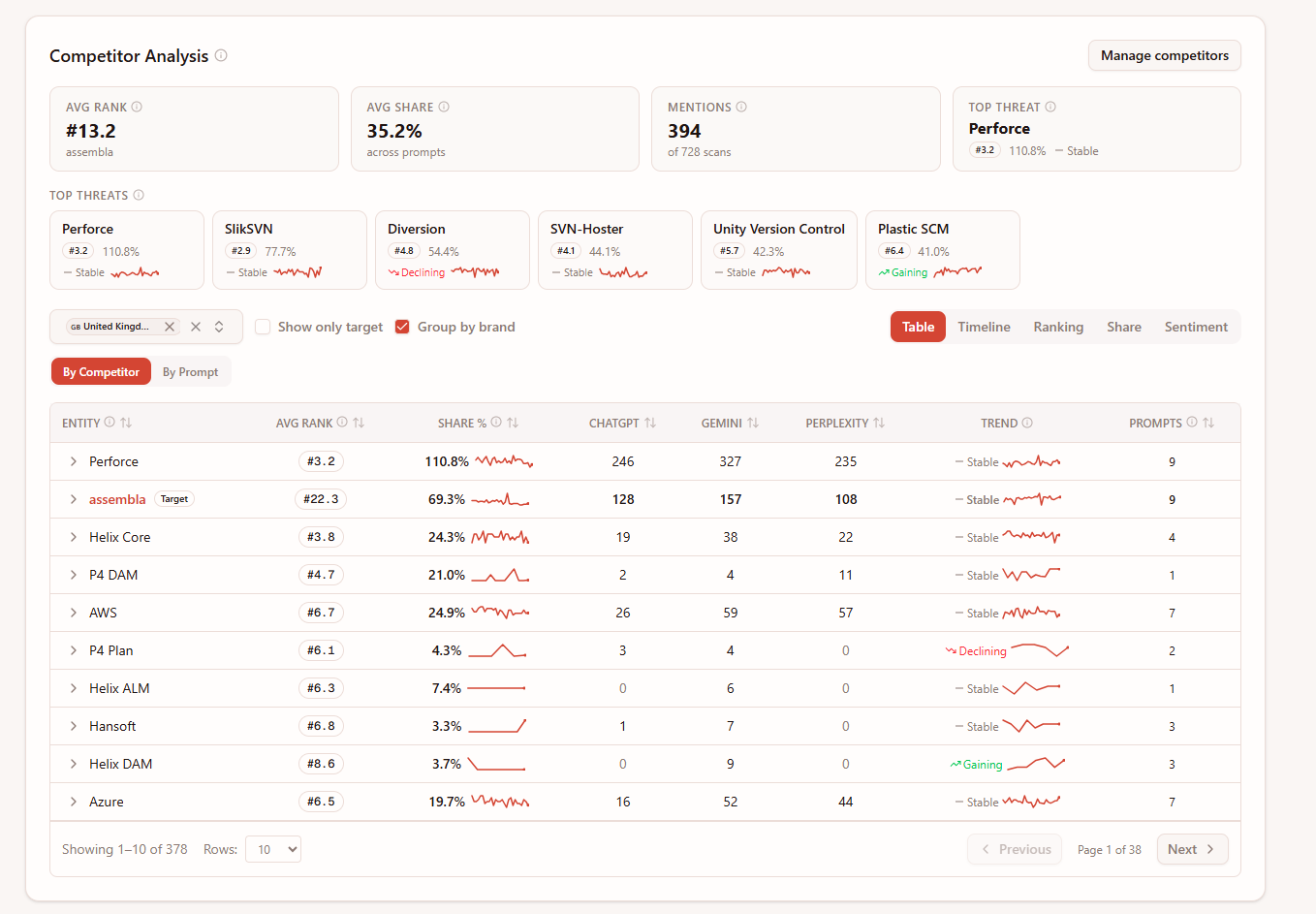
Traditional SEO trained us to think in positions. AI search doesn't work that way. A model synthesizes an answer and names a handful of brands, and inclusion, not ordering, is what determines whether a buyer ever hears your name.
That makes competitor mentions uniquely revealing:
They are winner-take-most. A typical AI answer names two to five brands out of dozens in a category. Being brand number six is functionally identical to not existing.
They are invisible in your analytics. Zero-click answers mean a competitor can win a buyer without a single referral hitting either of your servers.
They compound. Brands that get mentioned attract more coverage, more citations, and more third-party validation, which the models then read and cite again. The flywheel spins for whoever is already on it.
They are diagnosable. Unlike a Google ranking, an AI mention usually comes with visible reasoning and citations. You can see why a competitor won.
Tracking LLM Brand Visibility against your rivals is how you convert that invisible layer into a number you can manage.
The Four Types of Competitor Mentions
Not every mention is equal. Before you start counting, learn to classify what you find, because the response is different in each case.
1. The Default Recommendation
The competitor is named unprompted in open-ended category queries: "best tools for X," "who should I use for Y." This is the highest-value mention type and the hardest to displace. It signals the model has strong, repeated associations between the brand and the category.
2. The Comparison Anchor
The competitor is treated as the reference point everyone else is measured against — "similar to [Competitor], but cheaper." Being the anchor is powerful positioning. Being measured against the anchor is survivable, but it means you're playing defense on someone else's terms.
3. The Conditional Mention
The competitor appears only with qualifiers: "if you need enterprise SSO, consider X." This is a narrow win, and it's the easiest gap to attack. Find the conditions where your competitor owns the recommendation and build content that makes you the answer for those conditions.
4. The Cautioned Mention
The model names the competitor but attaches a reservation — pricing complaints, support issues, a limitation. These are gifts. They tell you exactly which objections the models have absorbed from public sources, and they map directly to differentiation messaging you can publish.
A Five-Step Framework to Track Competitor Mentions
Step 1: Define Your Real Competitive Set
Don't use your internal battlecard list. Run twenty open category prompts and record every brand the models name. You will almost always find two or three "AI-native" competitors — brands that rank poorly on Google but dominate AI answers because they're well covered in the sources models trust. Those are the ones to watch.
Step 2: Build a Prompt Set That Mirrors Buyer Behavior
Aim for 40–100 prompts spanning the funnel: category queries, comparison queries, use-case queries, problem queries, and objection queries. This prompt set becomes your permanent benchmark, so write it once and change it rarely — consistency is what makes the trendline meaningful.
Step 3: Measure Mention Rate, Not Rank
Run every prompt multiple times across ChatGPT, Perplexity, Gemini, and Claude. Model outputs are non-deterministic, so a single run is noise. The signal is mention rate: the percentage of runs in which a given brand appears. Track it for yourself and your top three to five competitors, and you have a share-of-voice figure that survives model volatility.
Step 4: Reverse-Engineer the Citations
For every prompt where a competitor beats you, capture the sources the model cited. Patterns emerge fast:
Roundup and listicle placements: "best X tools" articles on third-party sites are disproportionately influential.
Review platforms: G2, Capterra, and Trustpilot profiles with recent, detailed reviews.
Community threads: Reddit and niche forums carry more weight than most marketers expect.
Entity consistency: Wikipedia, Crunchbase, and structured data that describe the brand the same way everywhere.
Extractable content: direct, clearly-structured answers on the brand's own site that models can lift verbatim.
Step 5: Close the Gap, Then Re-Measure
Pick the three prompts with the largest gap and the clearest cause. Fix the cause — earn the roundup placement, refresh the review velocity, publish the comparison page, tighten your entity data. Then re-run the same prompt set 30 and 90 days later. Continuous LLM Visibility tracking is what separates a one-time audit from an actual growth loop.
A Realistic Example
A mid-market HR software company ran a 60-prompt benchmark across four models. Their own mention rate was 9%. A smaller, less-funded competitor scored 47%. The gap wasn't product quality — it traced to three roundup articles that every model kept citing, plus a Reddit thread with 200 upvotes recommending the rival by name.
Their response was unglamorous and effective: they pitched five relevant roundups, published two comparison pages answering the exact conditional queries where the rival won, and drove a review campaign that added 40 recent G2 reviews. At the 90-day re-measure, their mention rate had climbed to 31%. Nothing about that plan is possible without measuring competitor mentions first.
Mistakes That Waste the Effort
Testing once. Model outputs vary run to run. One test tells you nothing; twenty runs tell you the truth.
Tracking only your own brand. A 20% mention rate is excellent if the leader sits at 25% and disastrous if they sit at 70%. Context is the whole point.
Chasing position inside the answer. Ordering in AI answers is close to random. Inclusion is what you can influence.
Testing one model. Buyer attention is fragmenting across ChatGPT, Perplexity, Gemini, Claude, and Copilot. Each has its own citation habits and its own winners.
Ignoring sentiment. Being mentioned with a caveat is a different problem from not being mentioned at all — and it needs a different fix.
Conclusion
Competitor mentions in AI answers are the clearest early signal of who is winning the next era of discovery. They're measurable, they're diagnosable, and right now they're almost entirely unmeasured across most industries — which means the cost of starting is low and the advantage of starting early compounds.
Build the prompt set. Count the mentions. Read the citations. Fix the gaps. Then do it again next month. The brands that make this a habit in 2026 will be the defaults that everyone else is benchmarked against in 2027.
Want more playbooks like this on GEO, AI search, and brand visibility in LLMs? Subscribe to the newsletter and get every new guide delivered straight to your inbox.