

Ranking Doesn't Exist Here. Something Harder Does.
Ask ChatGPT for the best CRM for a 20-person sales team and you get four names in a paragraph. No numbered list of ten results. No page two. No position tracking tool that can tell you whether you were third or seventh, because "third" isn't a thing that happened.
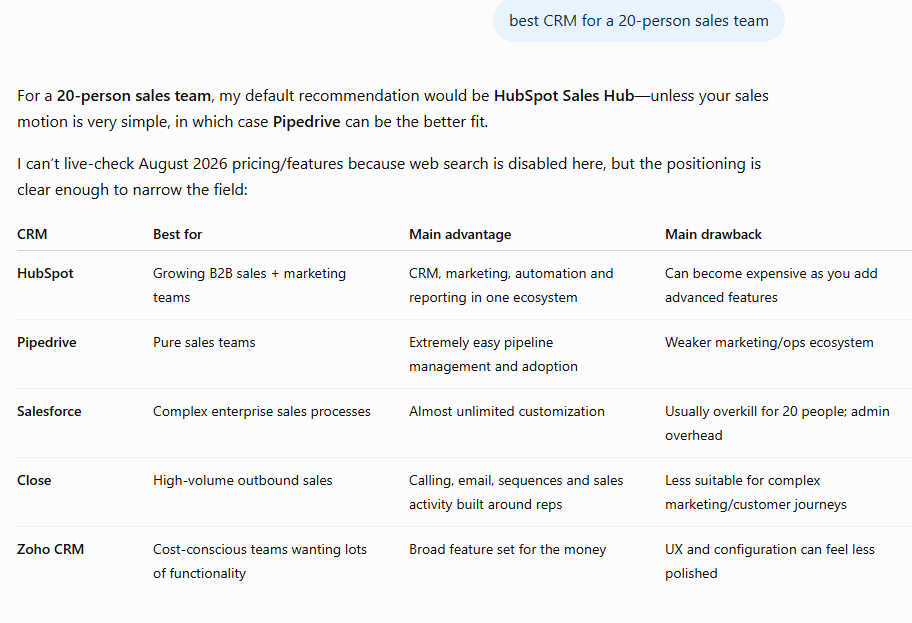
Yet somehow your competitor is in that paragraph and you aren't. That is a ranking outcome even if the mechanism has nothing to do with ranking.
Marketers keep asking the wrong version of this question. They want to know what position they hold. The useful question is why the model selected the brands it selected, out of the forty it could have named. That selection process is knowable. It is also, unlike Google's algorithm, mostly documented by the models themselves every time they cite a source.
The Four Inputs That Decide Who Gets Named
A language model assembling an answer about your category is pulling from four places at once. Your competitor is winning in at least one of them.

Training data density. How often the brand appeared in the text the model learned from, and in what context. A brand mentioned 400 times across review sites, forums, and trade publications before the training cutoff has a strong internal association with the category. A brand mentioned twice does not. This is the slowest input to move and the one most teams ignore entirely.
Retrieval sources at query time. Most AI search surfaces now fetch live pages before answering. Perplexity always does. ChatGPT does it for anything time-sensitive or specific. Whatever ranks in the underlying index — usually Bing or Google, sometimes a proprietary crawl — becomes candidate material. Traditional SEO still matters here, just as an input rather than an output.
Third-party consensus. Models weight sources that read as independent. A G2 category page, a Reddit thread with forty upvotes, a listicle on a publication with editorial history. Your own homepage carries almost no weight in this calculation. Your competitor's placement in "top 10 tools for X" articles carries a great deal.
Structural clarity of the source page. When a model reads a page and cannot tell what the product does, who it's for, or what it costs, it can't safely recommend it. Vague positioning is invisible positioning. Pages that state the category, the buyer, the constraint, and the price band get extracted cleanly.
Notice what isn't on that list. Domain authority as a standalone number. Backlink volume. Keyword density. The things your SEO dashboard measures are proxies at best.
Why Your Competitor Shows Up and You Don't
Run the diagnostic in this order. It moves from cheapest fix to slowest.
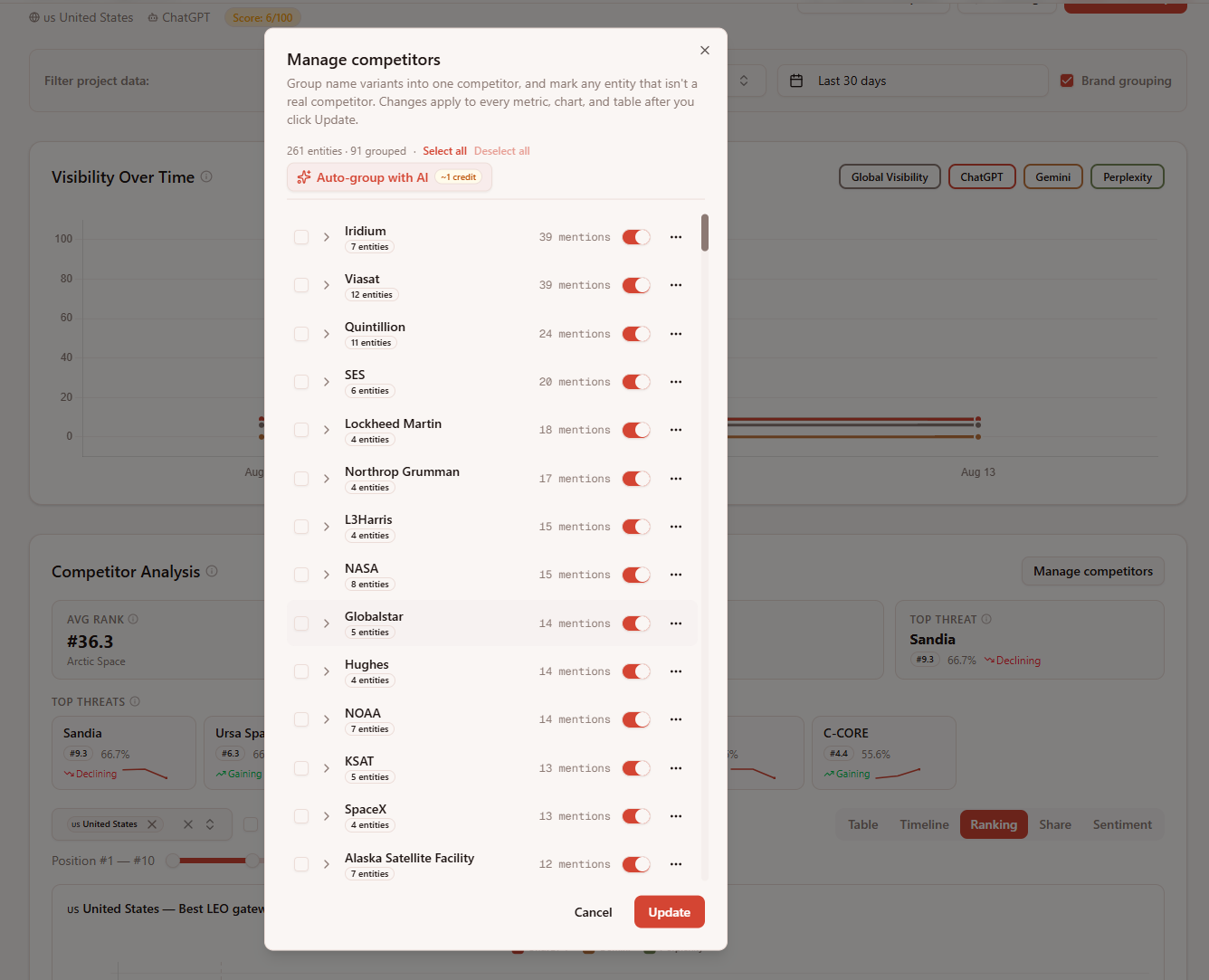
Start with whether you appear at all in unprompted category queries — questions with no brand names in them. If a competitor appears in 70% of runs and you appear in 5%, the gap is a presence problem, not a positioning problem, and no amount of website copy editing will close it.
Then check the citations. Every AI answer that names your competitor usually links to why. Pull those URLs. In most B2B categories you will find the same eight to twelve domains doing the heavy lifting: two review platforms, a handful of comparison articles, a Reddit thread, maybe a Wikipedia entry. That set of domains is your actual competitive battlefield. Auditing your LLM Visibility starts with knowing which of those twelve sources mention you and which don't.
Next, look at the framing. Sometimes you are named, but named badly — as the cheap option, or the one with a steep learning curve, or "good for enterprise" when you sell to startups. Being present with the wrong descriptor is worse than being absent, because the model is actively routing buyers away from you.
Finally, test the conditional queries. Add constraints: under $100 a month, HIPAA compliant, works with Shopify, best for teams under 10. Brands that lose the open query often win three conditional ones. Those wins are where a smaller brand realistically competes, because the constraint narrows the candidate pool to something you can dominate.
Measure Mention Rate, Not Position
Position is borrowed vocabulary from a different channel. The metric that works is mention rate — the percentage of runs, across a fixed prompt set, in which a brand appears.
Fix your prompt set at 40 to 100 queries and stop changing it. Run each prompt at least five times, because these systems are non-deterministic and a single run tells you nothing. Use fresh sessions with memory off, or you are measuring your own history.
Then track three numbers per competitor. Mention rate. Share of citations, meaning what percentage of cited sources are ones where that brand appears. And sentiment framing, sorted into positive, neutral, or cautioned.
Do this monthly. The trendline matters more than any single reading, because model updates move these numbers in ways that have nothing to do with your marketing.
What Actually Moves the Number
Closing a mention-rate gap takes one to two quarters, not one to two weeks. The levers, in rough order of return per hour spent:
Get into the comparison and listicle content the models already cite. You found those URLs in the citation audit.
Fix your review platform presence. Thirty recent G2 reviews beats two hundred from 2022.
Publish the comparison pages you'd rather not publish.
Answer conditional queries explicitly on-page. Models extract stated facts, not implied ones.
And restate the basics on every product page. Category. Buyer. Price band. Primary constraint you solve. Plain sentences, near the top. Strong LLM Brand Visibility is mostly this — written for a reader that isn't human.
The Part That Should Worry You
Every month you don't measure this, your competitor's association with your category strengthens in the training data of the next model generation. AI answer surfaces compound. A brand that dominates category answers in 2026 gets cited more, which produces more source material naming them, which trains the next model to name them more.
That flywheel is running right now, with or without you on it.
Start with one prompt set and one month of data. You will learn more about your competitive position in an afternoon than your last three quarterly SEO reports told you.
If you want the weekly breakdown of how AI search surfaces are shifting — which models changed their citation behavior, which categories flipped, what's working to close mention-rate gaps — subscribe below. One email, built for people who have to report these numbers to someone.