

Your next customer probably won't Google you. They'll ask ChatGPT. And when they do, one of two things happens: your brand gets named as the answer, or a competitor does. The uncomfortable truth is that most marketers have no idea which one is happening — because the question "how often does my brand appear in ChatGPT?" has no answer in Google Analytics, no row in your SEO dashboard, and no entry in your social listening tool. This is the single biggest blind spot in marketing right now, and closing it is the entire premise of LLM Visibility.
Why This Question Suddenly Matters

For two decades, "being found" meant ranking on a page of blue links. You could measure it, you could influence it, and you could watch it move. Generative AI broke that model. When someone asks ChatGPT "what's the best project management tool for agencies?" the model returns a synthesized recommendation — often naming three or four brands and ignoring everyone else. There is no page two. There is no scrolling. If you're not in the answer, you don't exist for that query.
That shift changes the core marketing question from "where do I rank?" to "how often am I mentioned, and in what context?" Appearing in one ChatGPT answer out of a hundred relevant prompts is very different from appearing in eighty. The frequency is the metric. And right now, most brands are flying blind on it.
What "Appearing in ChatGPT" Actually Means
Before you can measure frequency, it helps to be precise about what counts as an appearance. There are several distinct ways a brand can show up:
Direct recommendation: The model names your brand as an answer to a buyer-intent prompt ("the best tool for X is...").
Listed mention: Your brand appears in a list alongside competitors, without being singled out.
Cited source: In browsing or search-connected modes, ChatGPT links to your domain as a reference.
Contextual mention: Your brand comes up as an example, a comparison point, or background context.
Absence: The prompt is relevant to you, but you're never mentioned — the most important data point of all.
Tracking LLM Brand Visibility means counting all of these across a representative set of prompts, not just celebrating the occasional screenshot where you got named.
Why You Can't Just "Check It Yourself"

The intuitive approach is to open ChatGPT, type a few questions, and eyeball the results. This feels productive and is almost worthless as measurement. Here's why:
Answers are non-deterministic. Ask the same question twice and you can get different brands, different ordering, and different phrasing. A single check tells you nothing about frequency.
Personalization and memory skew results. Your own account's history influences what you see. The model may surface your brand to you precisely because you've searched it before.
Coverage is impossibly wide. Your buyers phrase questions hundreds of ways. Checking five prompts samples a fraction of a percent of the real surface area.
There's no trend line. A manual check is a snapshot. Visibility is something you manage over weeks and months, which means you need repeated, structured measurement.
Measuring how often your brand appears in ChatGPT is a sampling problem, and sampling problems require method, not vibes.
A Framework for Measuring ChatGPT Visibility
Here's a repeatable approach you can run — manually at small scale, or with a dedicated tool at real scale.
1. Build a Representative Prompt Set
Start with the questions your buyers actually ask. Pull them from sales calls, support tickets, your search console queries, and competitor comparison searches. Group them into intent buckets: top-of-funnel ("what is X"), commercial ("best X for Y"), and brand/competitor ("is BrandA better than BrandB"). Aim for breadth — fifty well-chosen prompts beat five obvious ones.
2. Run Each Prompt Repeatedly
Because answers vary, run every prompt multiple times in clean sessions (no login history bleeding in). Five to ten runs per prompt starts to reveal a stable pattern rather than a lucky hit.
3. Score Every Response
For each response, record whether your brand appeared, in what form (recommendation, list, citation, mention), its position, and the sentiment. Do the same for your top competitors so you have a benchmark.
4. Calculate Your Visibility Rate
The headline number is simple: of all the relevant prompts you tested, in what percentage did your brand appear at least once? Layer in share of voice — your mentions versus total competitor mentions — to understand not just whether you show up, but whether you're winning the conversation.
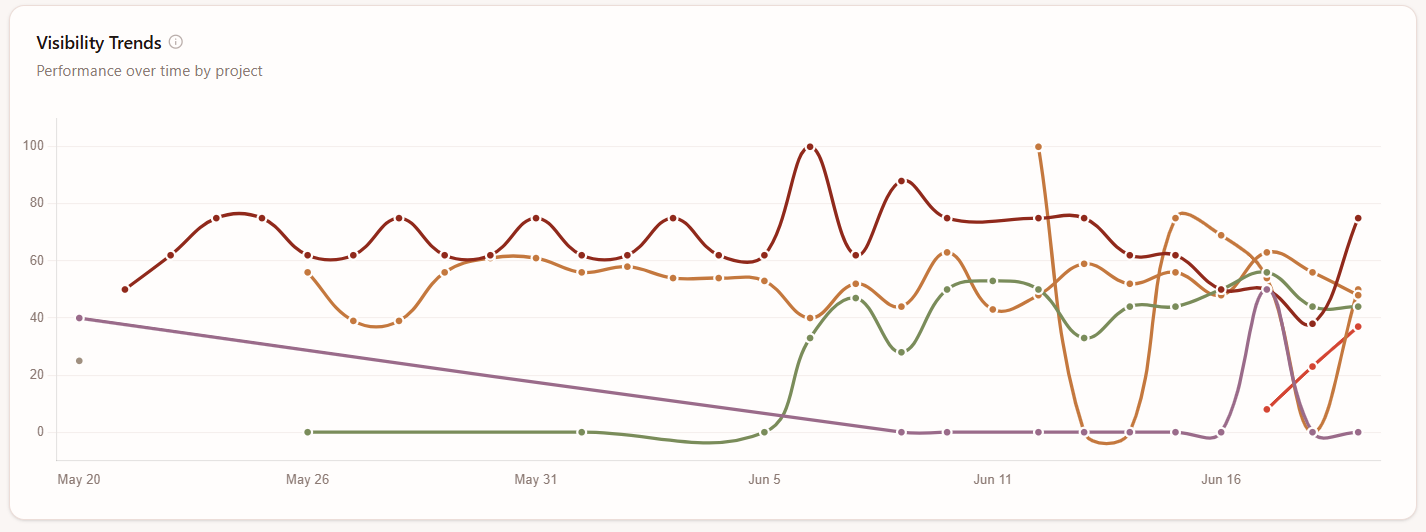
5. Track It Over Time
A single measurement is a baseline. The value comes from watching the line move as you publish content, earn citations, and strengthen your entity footprint. Visibility you can't trend is visibility you can't manage.
What to Do With the Number
Once you know your appearance rate, the work becomes strategic rather than guesswork:
Low visibility on commercial prompts signals you need authoritative, comparison-style content the model can extract and trust.
You're cited but not recommended suggests your content is reference-worthy but your positioning isn't crisp enough to earn the top spot.
A competitor dominates a prompt cluster tells you exactly where to concentrate your content and digital-PR effort.
Strong visibility that's slipping is an early-warning system — better to catch erosion in a dashboard than in a quarterly revenue miss.
This is the practical payoff of treating LLM Visibility as a managed metric: every number points to a specific action.
Stop Guessing. Start Measuring.
"How often does my brand appear in ChatGPT?" is no longer a curiosity — it's a core marketing KPI, and the brands that measure it now will own their categories in AI search before everyone else wakes up. You wouldn't run paid media without a dashboard or SEO without rank tracking. AI visibility deserves the same rigor. The first step is simply knowing your number, then watching it climb.
If you want frameworks, benchmarks, and tactical playbooks for winning visibility across ChatGPT, Perplexity, Gemini, and Claude, subscribe to the LLM Search Console newsletter. Every issue helps you turn AI search from a blind spot into your strongest channel — join us and start measuring what actually moves your brand.