

Search is no longer a list of ten blue links. When someone asks ChatGPT, Perplexity, Gemini, or Copilot for a product recommendation, your brand either shows up in the answer or it doesn't — and there's no "page two" to fall back on. If you're a marketer, founder, or brand manager, the question is no longer "where do we rank on Google" but "does AI even know we exist, and does it trust us enough to recommend us?"
This shift matters right now because AI-generated answers are quietly replacing a huge share of research and discovery queries. Buyers are forming opinions about your category — and your competitors — based on what a language model says in a single response. If your brand isn't part of that response, you're invisible at the exact moment a decision is being made.
Why Brand Visibility in AI Search Is Different
Traditional SEO rewarded keyword targeting, backlinks, and technical optimization aimed at crawlers and ranking algorithms. AI search engines work differently:
They synthesize an answer from multiple sources rather than returning a ranked list.
They favor brands that appear consistently and credibly across the web, not just on your own site.
They cite sources unevenly — some platforms (like Perplexity) show citations prominently, while others (like ChatGPT) often don't.
They can hallucinate or simply omit your brand entirely, even if you rank well on Google.
This is why LLM Brand Visibility has become its own discipline. It's not a subset of SEO — it's a parallel system that requires its own measurement and strategy.
Step 1: Find Out Where You Currently Stand
You can't improve what you don't measure. Before changing anything, run a baseline check across the major AI platforms:
Ask the questions your buyers ask
Take your top 10-20 buyer-intent queries (e.g. "best project management tool for small teams") and run them through ChatGPT, Gemini, Claude, and Perplexity. Note whether your brand appears, how it's described, and which competitors show up instead.
Track your share of voice
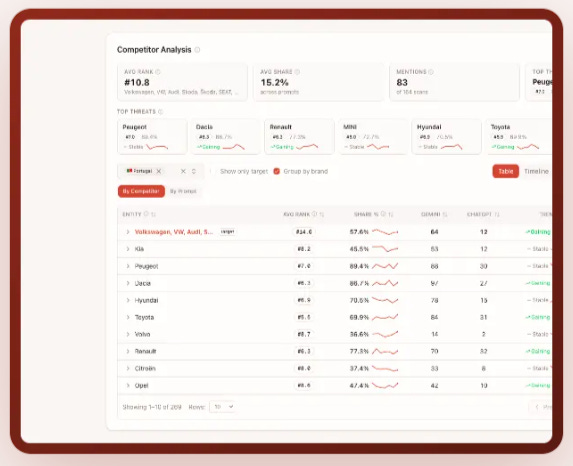
Share of voice in AI search measures how often your brand appears relative to competitors across a defined set of prompts. A low share of voice in a category where you're a known player is a strong signal that your content isn't reaching the sources these models rely on.
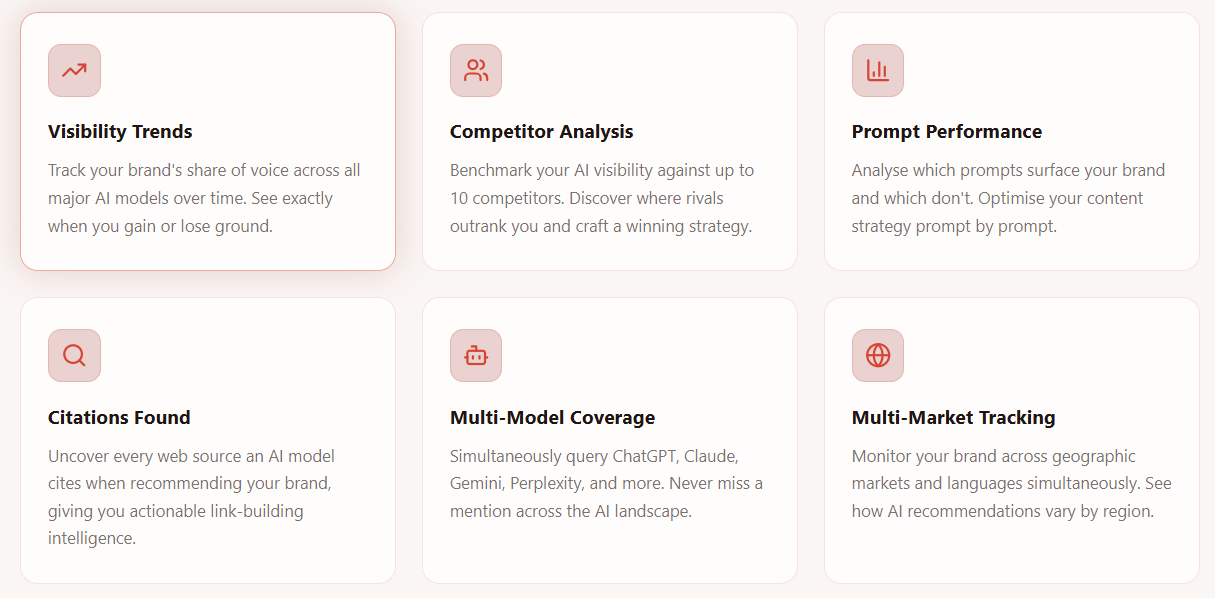
Manually repeating this process weekly doesn't scale, which is why ongoing LLM Visibility tracking tools exist — they automate prompt testing across platforms and chart your visibility trend over time.
Step 2: Strengthen Your Entity Authority
Large language models build an internal "understanding" of your brand as an entity — what you do, who you serve, and how trustworthy you are. This understanding comes from patterns across the web, not just your homepage.
Wikipedia and Wikidata: If your brand qualifies, a well-maintained entry gives models a clean, structured reference point.
Consistent NAP and descriptions: Make sure your brand name, category description, and value proposition are consistent across your site, directories, review platforms, and social profiles.
Third-party mentions: Reviews, comparison articles, podcasts, and press coverage all feed the training and retrieval data models draw from. Earned media matters more here than it ever did for traditional SEO.
Structured data: Schema markup (Organization, Product, FAQ, Review) helps both traditional crawlers and AI retrieval systems understand who you are and what you offer.
Step 3: Create Content AI Models Want to Cite
AI search engines favor content that is direct, well-structured, and easy to extract. To improve your odds of being cited or referenced:
Answer the question in the first two sentences
Models (and the retrieval systems behind them) reward content that states a clear answer up front, then elaborates. Don't bury your point under three paragraphs of preamble.
Use clear structure
Headings, numbered steps, definition boxes, and comparison tables are easier for models to parse and extract than dense narrative prose.
Publish original data and frameworks
Unique statistics, named frameworks, and proprietary methodologies get cited and referenced far more than generic advice — both by other publishers (creating backlinks) and directly by AI models summarizing "what experts say."
Keep content current
AI models are sensitive to recency, especially for fast-moving categories. Outdated stats or deprecated product names can actively hurt how your brand is described.
Step 4: Monitor, Don't Guess
Brand visibility in AI search isn't a "set it and forget it" project. Models update, retrieval indexes refresh, and competitors publish new content constantly. A brand that's well-represented in ChatGPT this month could quietly disappear next quarter if a competitor publishes a stronger comparison page or earns a wave of new reviews.
The most effective teams treat this the way they treat analytics: a recurring dashboard, not a one-time audit. Platforms built specifically for LLM Visibility tracking let you monitor mention frequency, sentiment, share of voice, and citation sources across ChatGPT, Gemini, Claude, Perplexity, and Copilot in one place — so you can catch drops before they cost you pipeline.
Putting It All Together

Improving your brand's visibility in AI search comes down to four repeatable moves: measure where you stand today, strengthen the signals that build entity authority, produce content that's structured for extraction and citation, and monitor your progress continuously instead of relying on a single audit. None of these require reinventing your marketing strategy — they require pointing your existing content and PR efforts at a new set of "search engines" that work fundamentally differently than Google.
The brands that take this seriously now, while most competitors are still focused exclusively on traditional SEO, have a real window to become the default answer in their category.
Ready to See Where You Stand?
If you're not sure how your brand currently appears across ChatGPT, Gemini, Perplexity, and Claude, that's the first thing to fix. Subscribe to this newsletter for ongoing frameworks, case studies, and tactical guides on winning visibility in the age of AI search — and be the first to know when we publish new tools and benchmarks to help you track and grow your presence.