

The Quarterly Screenshot Habit Is Costing You Six Months
Someone on your team opens ChatGPT, types "best project management software," and pastes the answer into Slack. Three competitors named. You are not one of them. Panic for a day, then nothing changes until someone repeats the ritual next quarter.
That workflow has two failure modes. It catches the problem months after it started, and it cannot tell you whether the answer you screenshotted was typical or a fluke. These systems are non-deterministic, so the same prompt run five times returns five slightly different brand sets. One screenshot is a single sample of a distribution you have never measured.
Meanwhile the actual competitive movement happens in between your checks. A competitor lands a G2 category badge in March. By May they are in 80% of model answers. You find out in July.
Monitoring competitors in LLMs is a standing process, not an occasional look. What follows is how to build one that runs in under two hours a month.
Define the Prompt Set First, Then Freeze It

The biggest reason competitive tracking produces garbage is that the questions keep changing. If you tested fifteen prompts in January and twenty-two different ones in February, you have two unrelated snapshots, not a trend.
Build a fixed set of 40 to 100 prompts before you measure anything. Split them across four intents.
Category queries carry no brand names. "Best project management tool for agencies." "Software to manage freelance invoicing." These reveal who owns the default answer.
Comparison queries name two or more players. X vs Y. Alternatives to X. Run these both with your brand named and with only competitors named, because the second version shows whether models volunteer you unprompted.
Constrained queries add the buying conditions your real prospects have. Under $200 a month. SOC 2 compliant. Native Salesforce integration. Teams under fifteen people. Smaller brands routinely lose the open category query and win four constrained ones, and those wins are the realistic path to pipeline.
Problem queries skip the category entirely. "How do I stop losing track of client revisions." This is where a model recommends a solution shape before it recommends a vendor, and where category-adjacent competitors ambush you.
Freeze the list. Version it. Add prompts only at quarter boundaries, and note the date you added them.
Track Four Numbers Per Competitor
Anything more than four and the monthly review turns into a data-cleaning exercise nobody does twice.
Mention rate is the percentage of runs across your prompt set in which a brand appears. Run each prompt five times minimum, in fresh sessions with memory and personalization disabled. Otherwise you are measuring your own browsing history.
Citation share is the percentage of cited sources in your prompt set that mention a given brand. This is the leading indicator. Citations shift weeks before mention rates do, because the model has to find the source before it can trust the brand, which is why serious LLM visibility work starts at the source layer rather than on your own site.
Framing is how the brand gets described. Sort into positive, neutral, or cautioned. A competitor described as "the enterprise standard" and one described as "powerful but with a steep learning curve" have identical mention rates and completely different commercial outcomes. Being named badly is worse than being absent, because the model is actively steering buyers elsewhere.
Position within the answer matters less than marketers expect, but first-named brands do get disproportionate clicks. Log it as a tiebreaker, not a KPI.
Track these across at least three platforms. ChatGPT and Gemini lean on training-data associations. Perplexity is retrieval-heavy and cites everything, which makes it the cheapest place to see which sources are doing the work. Claude sits somewhere between. A competitor dominant in one and invisible in another tells you exactly which lever they pulled.
Build a Competitor Set That Reflects Reality
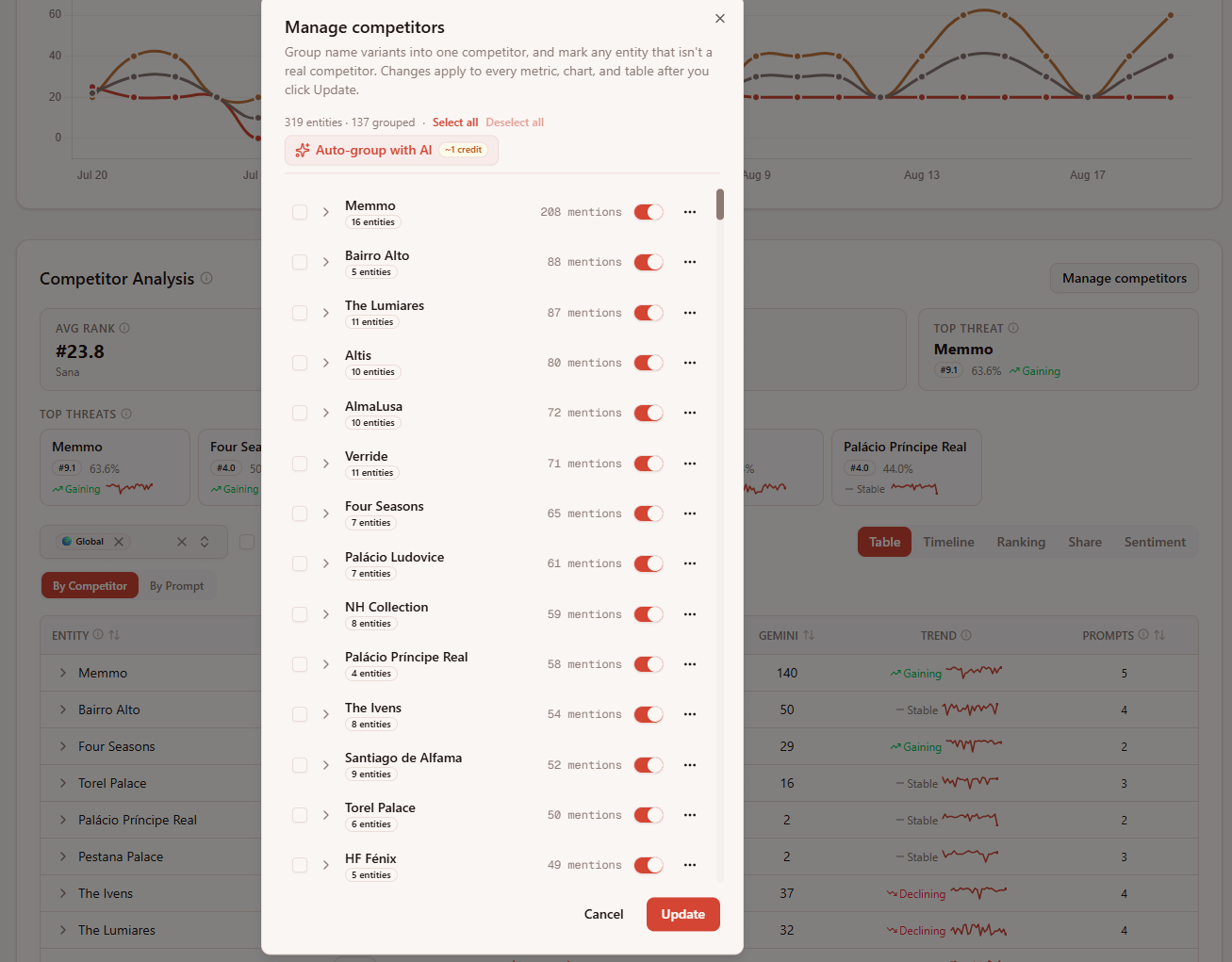
Your sales team's competitor list is not the model's competitor list. Models group by problem solved, not by market category as defined by analysts.
Run twenty category and problem queries. Log every brand named. Count frequency. The brands appearing in more than 30% of answers are your competitive set inside LLMs, regardless of what your battlecards say.
Two things usually surface. Some competitor you obsess over turns out to be nearly invisible to the models, meaning you are spending sales enablement budget on a ghost. And some company you have never heard of shows up constantly, usually because they published a definitive guide that everyone now cites.
Refresh this list twice a year. New entrants can go from zero to prominent in a single quarter if their content gets picked up by the right aggregator.
The Monthly Cadence That Actually Gets Done
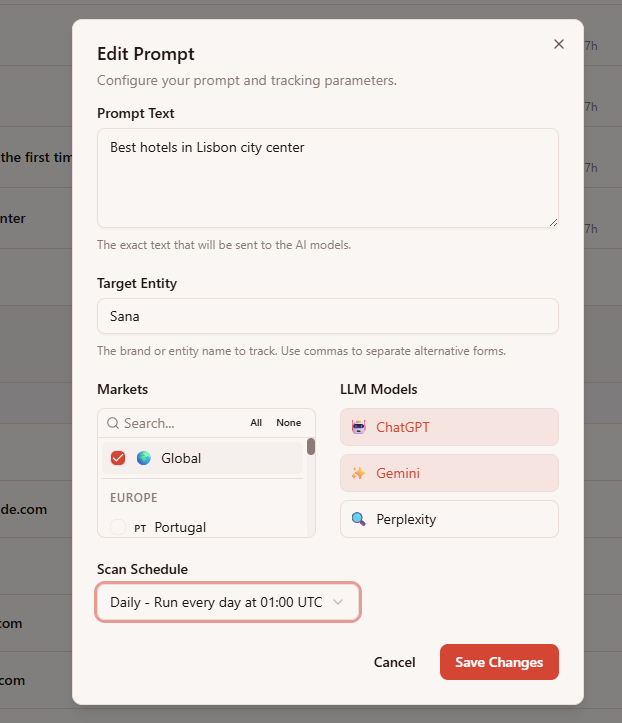
Run the full prompt set in the same week each month. Consistency of timing matters because model updates ship irregularly and you want your readings evenly spaced around them.
Pull citations for every answer where a competitor is named and you are not. In most B2B categories the same eight to twelve domains do the heavy lifting. Two review platforms, three or four comparison listicles, a Reddit thread, occasionally a Wikipedia entry. That domain set is the real battlefield. Strong LLM brand visibility comes from being present and accurately described across those twelve sources, not from another blog post on your own domain.
Compare against last month and flag anything that moved more than ten percentage points. Small movements are noise. Ten-point swings have causes, and the cause is almost always findable in the citation set.
Write three sentences on what changed and why. Not a dashboard. Three sentences, sent to the people who can act on them.
Two hours, monthly, and you have something no quarterly screenshot ever produced. A trendline.
Reading the Signals Correctly
Not every movement deserves a response.
A competitor's mention rate jumping across every platform in the same week usually means a model update reweighted something, or they landed a placement on a heavily cited source. Check the citations before you assume they outmarketed you.
A jump on Perplexity only, with ChatGPT flat, means fresh content got indexed. That is a retrieval win and it is reversible. You can compete for the same source within weeks.
A jump on ChatGPT and Gemini with Perplexity flat is the harder one. That is training-data density, built over months of accumulated mentions, and closing it takes a sustained campaign rather than a content sprint.
Your own mention rate dropping while nobody else's rises usually means a source that used to mention you got updated, delisted, or rewritten. Find it. Fix it there.
Where Most Monitoring Programs Break
Three failure patterns, in order of how often they show up.
Teams measure once and treat it as a baseline forever. A single month is a data point, not a baseline. You need three readings before any number means anything.
Teams run prompts in a logged-in session with memory on and personalization active, then wonder why they always appear. You are being shown your own reflection.
Teams collect the data and never route it anywhere. Mention rate that lives in a spreadsheet nobody opens is a hobby. Attach it to a monthly decision. Which source gets pitched next. Which comparison page gets rebuilt. Which review platform gets a customer campaign.
The teams that win here are not running more sophisticated analysis. They are running the same simple analysis every month for a year while everyone else screenshots quarterly.
Start Where the Gap Is Cheapest to Close
Pick fifteen prompts this week. Run each five times. Log which brands appear and which sources get cited. That single afternoon will tell you more about your competitive position in AI search than the last four quarters of guessing.
Then decide whether you are going to do it again next month. That decision, not the tooling, is what separates the brands models recommend from the brands they have never learned to associate with anything.
We publish practical breakdowns like this every week. Measurement frameworks, platform-specific tactics, and what is actually moving in AI search. Subscribe to get the next one in your inbox.