

Ask ChatGPT for "the best tools" in your category and read the answer carefully. Someone is being recommended by name, described in confident detail, and positioned as the obvious choice. If that someone is not you, you are watching competitive displacement happen in real time, and unlike a Google results page, there is no page two. Millions of buyers now start (and often end) their research inside AI assistants, which means the answer itself is the market. LLM competitive analysis is the discipline of systematically decoding that answer layer: who the models mention, how they describe them, which sources they lean on, and why. This article gives you a complete framework to run it yourself.
What Is LLM Competitive Analysis?
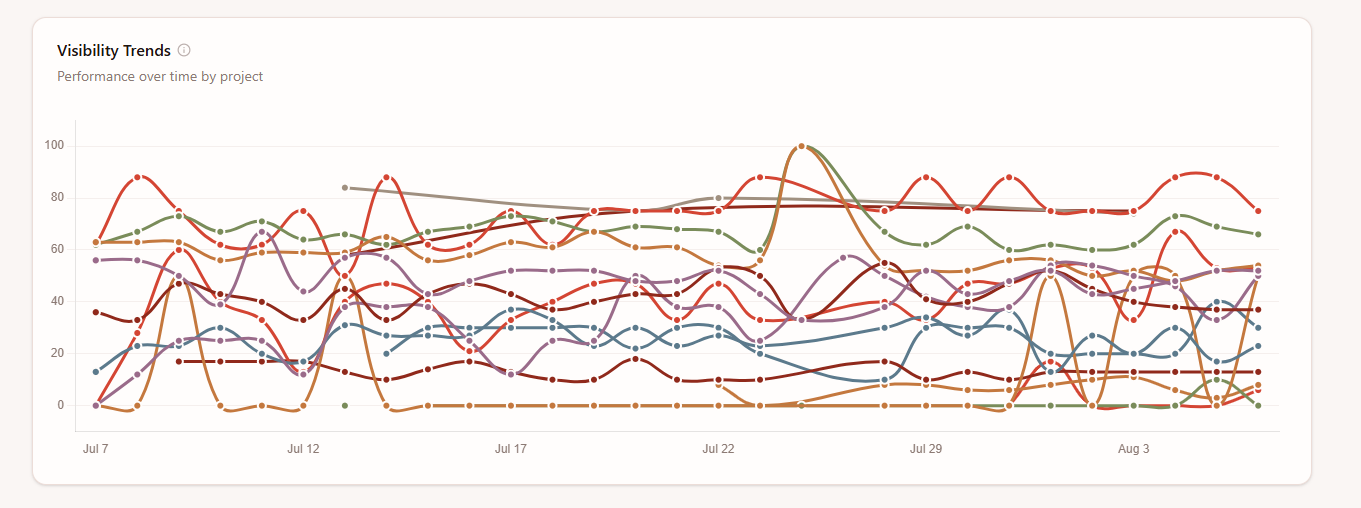
LLM competitive analysis is the process of measuring and comparing how large language models — ChatGPT, Perplexity, Gemini, Claude, Copilot — represent you versus your competitors across the prompts your buyers actually ask. It is the AI-era successor to keyword rank tracking, and it feeds directly into your broader LLM visibility strategy. Where traditional competitive analysis asks "who ranks above us on Google?", LLM competitive analysis asks harder questions: Which brands get named first in recommendation answers? How does the model describe each competitor's strengths? Whose content gets cited as evidence? And what does the model say when a buyer asks it to compare us head-to-head?
Why Traditional Competitive Analysis Misses the AI Layer
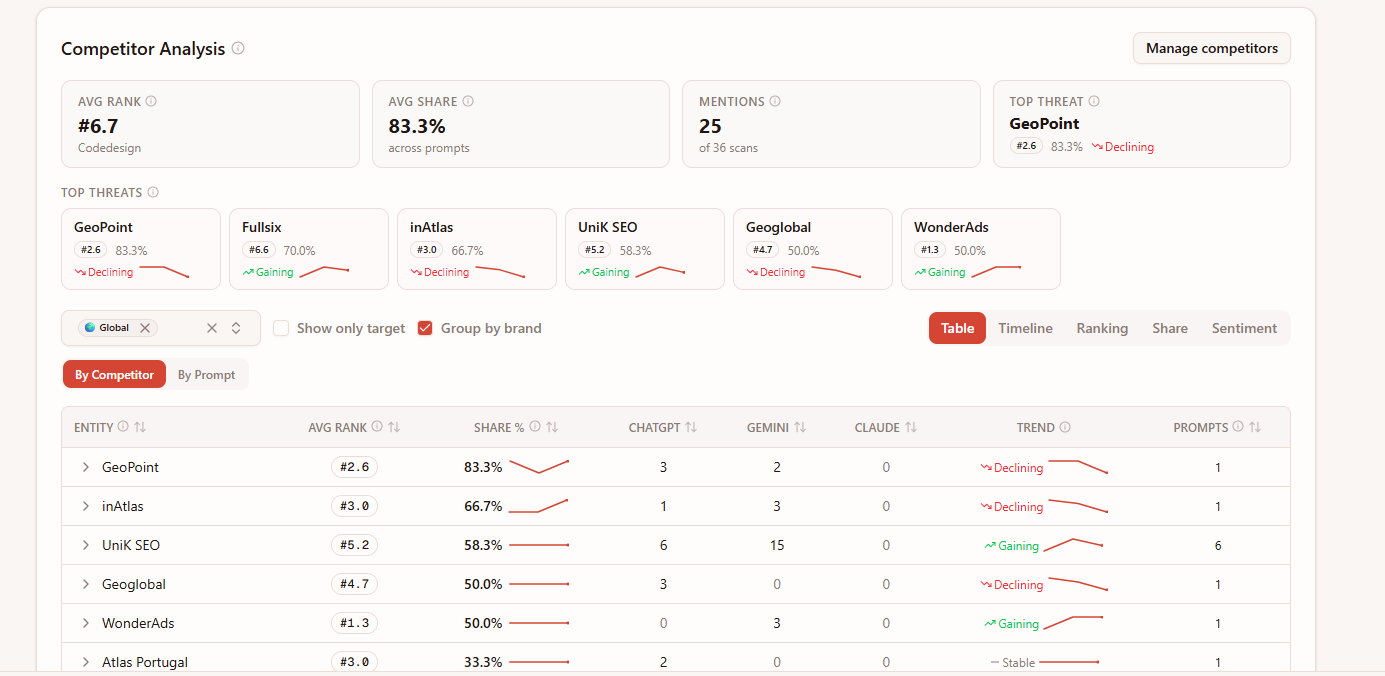
Most competitive dashboards were built for a search world that is rapidly shrinking. They miss the AI layer for a few structural reasons:
Answers are synthesized, not listed. An LLM does not show ten links — it composes one answer. Being "ranked third" often means being invisible, because the model may only name one or two brands.
Probabilistic results. The same prompt can produce different brand mentions across runs, models, and phrasings. A single spot-check tells you almost nothing; you need repeated sampling.
No referral trail. When a buyer takes the AI's recommendation and types your competitor's name directly into their browser, your analytics record it as branded direct traffic. The competitive loss never shows up in any report.
Narrative matters as much as presence. Being mentioned as "a budget alternative with limited features" is arguably worse than not being mentioned. Traditional tools measure position; the AI layer requires measuring sentiment and framing.
The Five-Step LLM Competitive Analysis Framework
Step 1: Define Your Prompt Space
Start with 30–50 prompts that mirror real buyer journeys, spread across three intent tiers: category prompts ("best AI brand monitoring tools"), problem prompts ("how do I track what ChatGPT says about my company"), and comparison prompts ("X vs Y, which should I choose"). Write each prompt in several natural phrasings — models answer "top tools for..." differently from "what should I use for...". This prompt set becomes your fixed measurement panel, the equivalent of a keyword portfolio in classic SEO.
Step 2: Capture the Answer Set Across Models
Run your prompt panel across every model your buyers use — at minimum ChatGPT, Perplexity, and Gemini, and ideally Claude and Copilot too, since coverage differs sharply between them. Record the full answer text, every brand mentioned, mention order, the descriptive language used, and every citation. Because answers are probabilistic, sample each prompt multiple times so you measure rates instead of one-off snapshots.
Step 3: Measure Share of Voice and Mention Rate
Now quantify. Two metrics carry most of the weight: mention rate (the percentage of runs in which a brand appears for a given prompt) and AI share of voice (a brand's mentions as a percentage of all brand mentions across the panel). Break both down by model and by intent tier. The pattern that emerges is your real competitive map — and it rarely matches your Google rankings. A rival with mediocre SEO can dominate AI answers because their content happens to be highly quotable and well-grounded.
Step 4: Run a Citation Gap Analysis
For every answer that cites sources, log which domains the models trust. Then ask: which sources cite our competitors but not us? Those third-party listicles, review sites, community threads, and industry publications are the grounding layer your rivals are winning. A citation gap list converts directly into an outreach and PR roadmap — it is often the fastest lever for improving LLM brand visibility, because models re-crawl trusted sources far more often than they retrain.
Step 5: Decode the "Why" Behind Rival Recommendations
Finally, study the language of the answers themselves. When a model recommends a competitor, it usually explains why — "known for its enterprise integrations," "praised for ease of use." Those phrases are fingerprints of the training and grounding data. Cluster them and you get a precise readout of the narrative each competitor has seeded across the web, and of the claims you need to substantiate publicly to compete for the same recommendation slots.
Turning Analysis Into Action

Analysis only matters if it changes what you ship next quarter. The highest-leverage moves, in rough order of speed:
Close the citation gap. Pitch the exact publications and review platforms the models already cite for your rivals.
Publish comparison content. Models love structured, factual head-to-head pages. If you do not publish the comparison, the model composes one without your input.
Make your strengths quotable. Convert vague marketing copy into specific, verifiable claims with numbers — the format models extract and repeat.
Fix the narrative, not just the mention. If models describe you inaccurately, publish authoritative correcting content on the pages models cite most.
Re-measure monthly. AI answers shift with model updates and fresh crawls; a quarterly cadence is too slow to catch displacement.
The Compounding Advantage of Starting Now
The uncomfortable truth about the AI answer layer is that it compounds. Models ground new answers in sources that already cite the brands they already know, which means today's leaders get progressively harder to displace. Most companies still are not measuring any of this — which makes right now the cheapest moment to build the discipline. Run the five steps above once and you will know more about your AI-era competitive position than most of your rivals know about theirs. Automate it, and you will see every displacement attempt as it happens instead of quarters later. If you want the measurement layer handled for you — prompt panels, share of voice, citation gaps, and sentiment across every major model — that is exactly what LLM Search Console was built for.
Enjoyed this playbook? Subscribe to the newsletter to get every new framework on AI search visibility, GEO, and competitive intelligence delivered straight to your inbox.