

Why Your Google Rankings No Longer Tell the Full Story
Something shifted in how buyers find brands—and most marketing teams haven't caught up yet. When a potential customer asks ChatGPT "what's the best CRM for a 50-person SaaS company?" or queries Perplexity for "top project management tools for remote teams," your Google ranking is completely irrelevant. What matters is whether your brand appears in the AI-generated answer at all.
This is the new visibility gap. And the only way to close it is through LLM visibility tracking.
In this guide, we break down exactly what LLM visibility tracking is, why it's become a category-defining capability for growth-focused brands, and how to build a measurement framework before your competitors do.
What Is LLM Visibility Tracking?
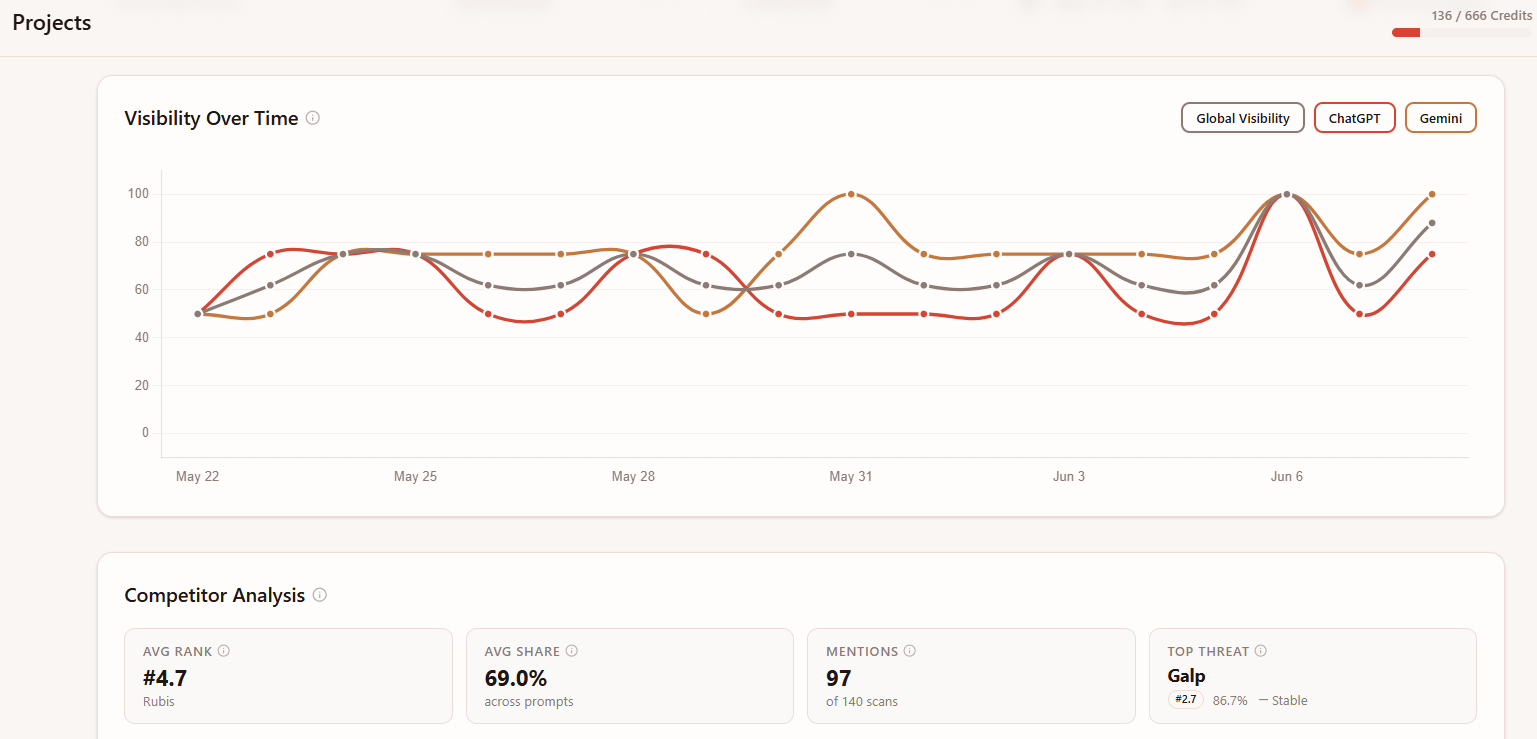
LLM visibility tracking is the practice of systematically monitoring how often—and how favorably—your brand appears in responses generated by large language models like ChatGPT, Perplexity, Gemini, Claude, and Grok. Think of it as the AI equivalent of rank tracking in traditional SEO, but instead of positions on a search results page, you're measuring presence and sentiment inside AI-generated answers.
A complete LLM visibility tracking setup captures:
Brand mention rate — what percentage of relevant AI queries include your brand name
Share of voice — how your brand's mention frequency compares to key competitors across the same query set
Sentiment and framing — whether the AI presents your brand positively, neutrally, or with qualifications
Citation presence — whether AI systems (especially Perplexity and AI Overviews) link back to your content as a source
Platform coverage — which LLMs mention you and which ones ignore you entirely
Why 2026 Is the Year This Becomes Non-Negotiable
AI-assisted search is no longer a fringe behavior. Industry data shows that a significant and growing share of informational and commercial queries now start—or end—inside an LLM interface. For B2B buyers especially, AI assistants have become the first stop for category research, vendor shortlists, and competitive comparisons.
The brands that appear consistently in those answers aren't winning by accident. They've invested in understanding and improving their LLM brand visibility—and they're tracking the results with the same rigor they apply to paid media or organic search.
If your marketing dashboard still only shows organic traffic, keyword rankings, and impressions, you're flying blind on one of the fastest-growing acquisition channels of the decade.
How LLM Visibility Tracking Works in Practice
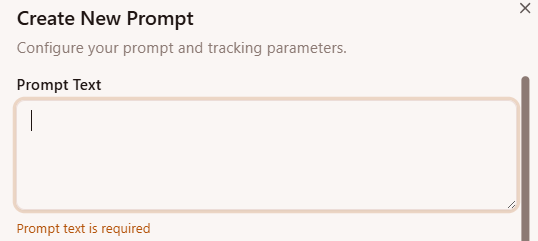
Step 1: Define Your Prompt Set
Start by identifying the queries your target buyers are actually asking AI systems. These aren't necessarily the same as your SEO keyword list. LLM queries tend to be conversational and intent-rich—think "what tools do B2B marketers use to track brand mentions" rather than "brand mention tool."
Build a prompt set of 20–100 queries across:
Category-level questions (what is the best X for Y use case)
Comparison queries (X vs. Y, alternatives to Z)
Pain-point questions (how do I fix / how do I measure / why isn't my brand...)
Brand-direct queries (what is [your brand], reviews of [your brand])
Step 2: Run Queries Systematically Across LLMs
Manually checking a handful of prompts in ChatGPT once a month isn't tracking—it's sampling. True LLM visibility tracking requires running your full prompt set across multiple models on a regular cadence (weekly or daily for high-stakes categories) and logging the structured outputs.
Because LLM responses vary by session, time, and model version, you need statistically meaningful sample sizes to distinguish real visibility trends from noise. This is where a purpose-built platform becomes essential over manual spot-checking.
Step 3: Score and Benchmark
Raw mention counts are useful but insufficient. A robust tracking framework produces:
Visibility Rate — brand mentions ÷ total queries run (your core KPI)
AI Share of Voice — your visibility rate relative to named competitors
Sentiment Score — positive, neutral, or negative framing in mentions
Citation Rate — percentage of mentions accompanied by a source link
Benchmarking these metrics against competitors transforms LLM brand visibility data from a vanity metric into a competitive intelligence tool.
Step 4: Diagnose and Optimize
Visibility gaps reveal specific optimization opportunities:
Low mention rate overall → Your brand lacks sufficient web authority or content depth for LLMs to confidently surface it. Prioritize entity establishment and authoritative content creation.
Low mention rate on specific query types → You're missing content that directly addresses those use cases or questions.
Negative sentiment in mentions → The AI has absorbed negative signals (reviews, articles, forum threads). Audit your brand's digital footprint and invest in reputation content.
Low citation rate despite mentions → Your content exists but isn't structured for AI extractability. Improve schema markup, structured formatting, and factual density.
The Competitive Intelligence Angle

One of the most underused applications of LLM visibility tracking is competitor benchmarking. When you run the same prompt set for your brand and three to five competitors, you get a real-time map of who AI systems consider the category authority—and exactly where the gaps are.
This data answers questions that traditional competitive intelligence tools can't:
Which competitors are gaining ground in AI recommendations that aren't yet showing in organic rankings?
Where does a competitor appear in AI answers while your brand doesn't—and what content are they using to earn that presence?
How does share of voice in AI answers correlate with share of voice in paid and organic channels?
For CMOs making the case for investment in AI search optimization, competitive benchmarking data is often the most compelling internal argument available.
Common Mistakes Brands Make When Starting Out
Mistake 1: Treating LLM Visibility Like SEO Rank Tracking
AI-generated responses don't have stable "positions" the way search results do. Two identical queries can return different brand mentions on different days. The right framing is probability and rate, not rank.
Mistake 2: Checking Only ChatGPT
ChatGPT is the highest-profile LLM, but Perplexity drives significant referral traffic (especially in research and B2B contexts), Gemini owns a large share of mobile query volume, and Claude is increasingly used in enterprise workflows. A complete picture requires cross-platform tracking.
Mistake 3: Ignoring Sentiment
Being mentioned isn't the same as being recommended. If an LLM mentions your brand alongside a caveat ("X is popular but some users report onboarding friction"), that framing can suppress conversion even when visibility is high. Sentiment tracking is non-optional.
Mistake 4: No Connection to Content Strategy
LLM visibility tracking is only valuable if it feeds a feedback loop. The insights should directly inform what content you create, update, and distribute—closing the gap between what AI systems know about your brand and what you want them to say.
Building Your LLM Visibility Tracking Stack
For teams getting started, a practical stack looks like this:
Tracking platform — A tool purpose-built for LLM visibility tracking that runs systematic queries, logs responses, and surfaces trends over time. This is the foundation.
Prompt management — A structured library of your tracking queries organized by intent, product area, and competitive set. Treat this like a keyword list—it needs regular review and expansion.
Reporting cadence — Weekly visibility snapshots for active campaigns; monthly strategic reviews that tie visibility trends to content calendar decisions.
Attribution integration — Connecting AI referral traffic (sessions from ChatGPT, Perplexity, etc.) to CRM and conversion data so you can model the revenue impact of visibility improvements.
What Good LLM Visibility Looks Like
Brands with strong LLM brand visibility share several characteristics. They have high-quality, factually dense content that LLMs can extract and cite cleanly. They've invested in entity establishment—ensuring that structured data, third-party coverage, and consistent NAP signals give LLMs confidence in who they are and what they do. They appear in authoritative third-party sources (G2, review aggregators, industry publications) that LLMs heavily weight. And they monitor and respond to their brand's AI footprint the same way a strong SEO team monitors and responds to ranking changes.
The result is a compounding advantage: brands that track and optimize their LLM visibility build a larger, more favorable AI presence over time, while brands that ignore it find themselves increasingly absent from the buyer journeys that matter most.
The Bottom Line
LLM visibility tracking is no longer optional for brands that compete for buyer attention online. As AI-assisted search becomes the dominant mode of discovery for B2B and high-consideration B2C purchases, your presence—or absence—in AI-generated answers will increasingly determine whether prospects ever reach your website at all.
The brands building their LLM visibility tracking capabilities now are securing a durable competitive moat. The ones waiting are ceding ground that will be harder and harder to reclaim.
Start tracking. Start optimizing. The window to establish early authority in AI search is still open—but it won't be forever.
Want to stay ahead of the curve on AI search visibility? Subscribe to the LLM Search Console newsletter for weekly insights on LLM visibility tracking, generative engine optimization, and brand monitoring strategies built for the AI-first era. Join thousands of marketers and founders already using these frameworks to win in AI search.