

Your brand might be invisible right now — and you wouldn't know it.
Not invisible on Google. Invisible in the place where your customers are increasingly going first: AI chat interfaces. When someone asks ChatGPT "what's the best project management tool for remote teams?" or asks Perplexity "which CRM do agencies use?" — does your brand show up? Do your competitors?
If you can't answer that question with data, you're flying blind in the most important new marketing channel of the decade.
This is exactly why a new category of software has emerged: the AI search visibility tool. And in 2026, it's becoming as essential as a rank tracker was in 2015.
What Is an AI Search Visibility Tool?
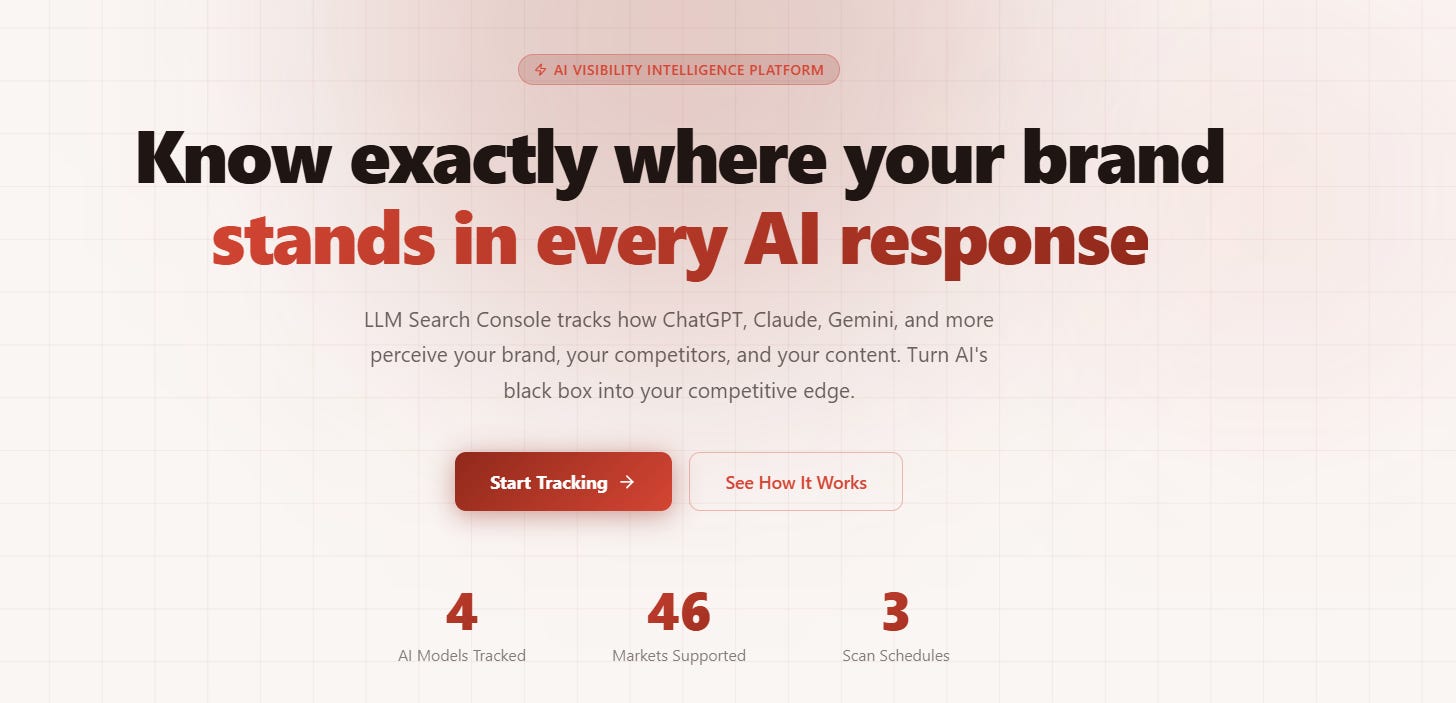
An AI search visibility tool is software that monitors and measures how often — and how favorably — your brand appears in responses generated by large language models (LLMs) like ChatGPT, Perplexity, Gemini, Claude, and others.
Think of it as Google Search Console, but for AI engines. Instead of tracking keyword rankings on a SERP, it tracks LLM visibility — how prominently your brand gets mentioned, recommended, or cited when AI systems answer questions relevant to your category.
A good AI search visibility tool typically covers:
Brand mention tracking across multiple AI platforms (ChatGPT, Perplexity, Gemini, Claude, Grok, and more)
Share of Voice (SoV) measurement — what percentage of AI responses in your category include your brand vs. competitors
Sentiment analysis — when your brand is mentioned, is the framing positive, neutral, or negative?
Competitor benchmarking — how does your brand's AI visibility compare to rivals?
Citation tracking — which of your pages or content assets are being cited as sources?
Prompt-set monitoring — tracking visibility across a curated set of buyer-intent queries relevant to your market
Why Traditional Analytics Tools Miss This Entirely
Google Analytics, SEMrush, Ahrefs — these are exceptional tools for the web as it was. But they were built for a world where users click links, visit pages, and generate traffic you can measure.

The AI search paradigm breaks this model in two critical ways:
1. Zero-Click Brand Exposure
When a user asks an AI engine a question, they often get a complete answer without ever clicking a link. Your brand might be recommended — or pointedly not recommended — and that interaction is completely invisible to your existing analytics stack.
2. AI Engines Don't Crawl Like Google
AI models form their understanding of your brand from training data, cited sources, and real-time retrieval (in the case of RAG-enabled systems like Perplexity). The signals that drive LLM brand visibility are fundamentally different from the signals that drive Google rankings.
Without a dedicated AI search visibility tool, you have no window into this channel at all.
What to Look for in an AI Search Visibility Tool
Not all tools in this space are equal. Here's what separates a genuinely useful platform from a gimmick:
Multi-Model Coverage
Your customers aren't all using the same AI engine. A tool that only monitors ChatGPT is like an SEO tool that only tracks rankings on Bing. Look for coverage across ChatGPT, Perplexity, Gemini, Claude, and emerging players like Grok.
Prompt-Set Customization
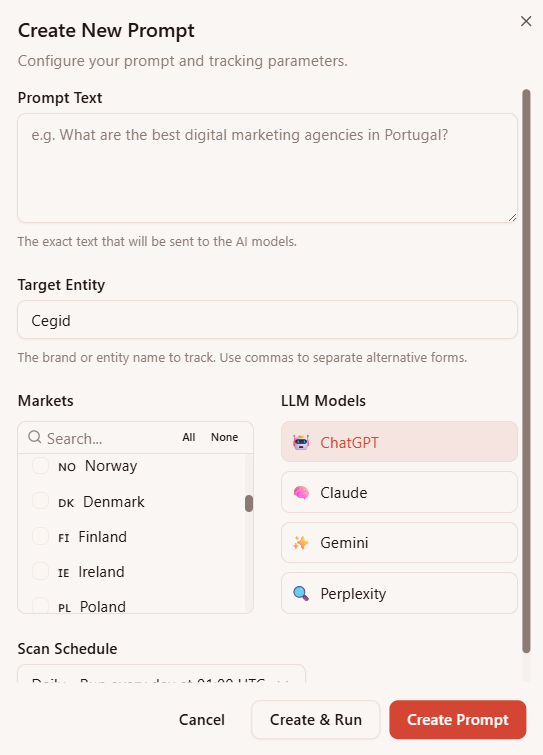
Your brand's visibility depends heavily on what questions you're measuring against. The best tools let you build a custom prompt set that mirrors real buyer-intent queries in your category — not just generic brand name searches.
Share of Voice Metrics
Knowing your brand appears in AI responses is useful. Knowing you appear in 34% of relevant queries while your top competitor appears in 61% is actionable. Prioritize tools that give you competitive SoV data, not just vanity mention counts.
Trend Tracking Over Time
LLM visibility fluctuates as models are updated, retrained, and fine-tuned. A good tool tracks your visibility rate over time so you can spot drops (and investigate why) or gains (and understand what drove them).
Citation and Source Attribution
If a specific blog post, product page, or third-party review is driving AI citations, you need to know that. Source-level attribution lets you double down on what's working and identify content gaps.
How Brands Are Using AI Visibility Tools Right Now
The CMO Competitive Play
Marketing leaders at mid-market SaaS companies are running weekly reports comparing their AI Share of Voice against 3–5 direct competitors. When a competitor's visibility spikes after a major press mention or product launch, they can see it — and respond with their own content and PR push.
The Content Team's New Editorial Calendar
Instead of building content calendars based purely on Google search volume, content teams are now auditing which buyer-intent questions their brand isn't showing up for in AI responses. The gap is their editorial roadmap.
The PR Team's Reputation Firewall
AI engines sometimes get things wrong — outdated information, incorrect attributions, or competitor-favoring framing. Brand monitoring teams are using AI visibility tools to catch these issues early, then working to correct the underlying data sources (Wikipedia entries, press coverage, structured data) that inform AI responses.
The Agency Reporting Upgrade
Agencies managing brand visibility for clients are adding an AI visibility dashboard to their monthly reporting. It's a compelling differentiation: "We don't just track how you rank on Google — we track how you show up when your customers ask AI."
Getting Started: A Practical Framework
If you're evaluating AI search visibility tools, here's a simple framework to get maximum value from day one:
Step 1: Define your prompt set. List 20–40 questions a buyer in your category would ask an AI engine. Include category queries ("what's the best [category] tool?"), problem-based queries ("how do I solve [pain point]?"), and comparison queries ("X vs Y").
Step 2: Establish a baseline. Run your prompt set across the major AI engines and document your current visibility rate and Share of Voice. This is your benchmark.
Step 3: Map your competitive landscape. Identify 3–5 competitors and track their visibility alongside yours. The goal isn't just to appear — it's to appear more than the alternatives.
Step 4: Audit your citation sources. Find out which content assets are driving AI citations today. Double down on formats that work (often: detailed guides, comparison pages, structured FAQ content).
Step 5: Establish a monitoring cadence. AI model updates can shift visibility overnight. Set up weekly or bi-weekly monitoring so you catch changes before they become entrenched problems.
The Window Is Open — But Not Forever
AI search visibility is an emerging discipline, which means the brands that move now have a genuine first-mover advantage. The same way early SEO adopters captured rankings that took competitors years to dislodge, brands that build strong AI visibility today are building a durable asset.
The tools exist. The methodology is maturing. The only question is whether you'll start measuring before or after your competitors do.
Start Tracking Your AI Visibility Today
If you're ready to stop guessing and start measuring, LLM Search Console gives you the data you need to understand — and grow — your brand's presence across every major AI engine.
And if you want weekly insights on AI search strategy, competitive visibility, and the tactics that are actually working in 2026, subscribe to this newsletter. We break down the research, the tools, and the plays — so you can act on them before everyone else does.
Subscribe below and join thousands of marketers building their AI visibility strategy.