

A new chart from Microsoft Work Lab stopped me mid-scroll last week.
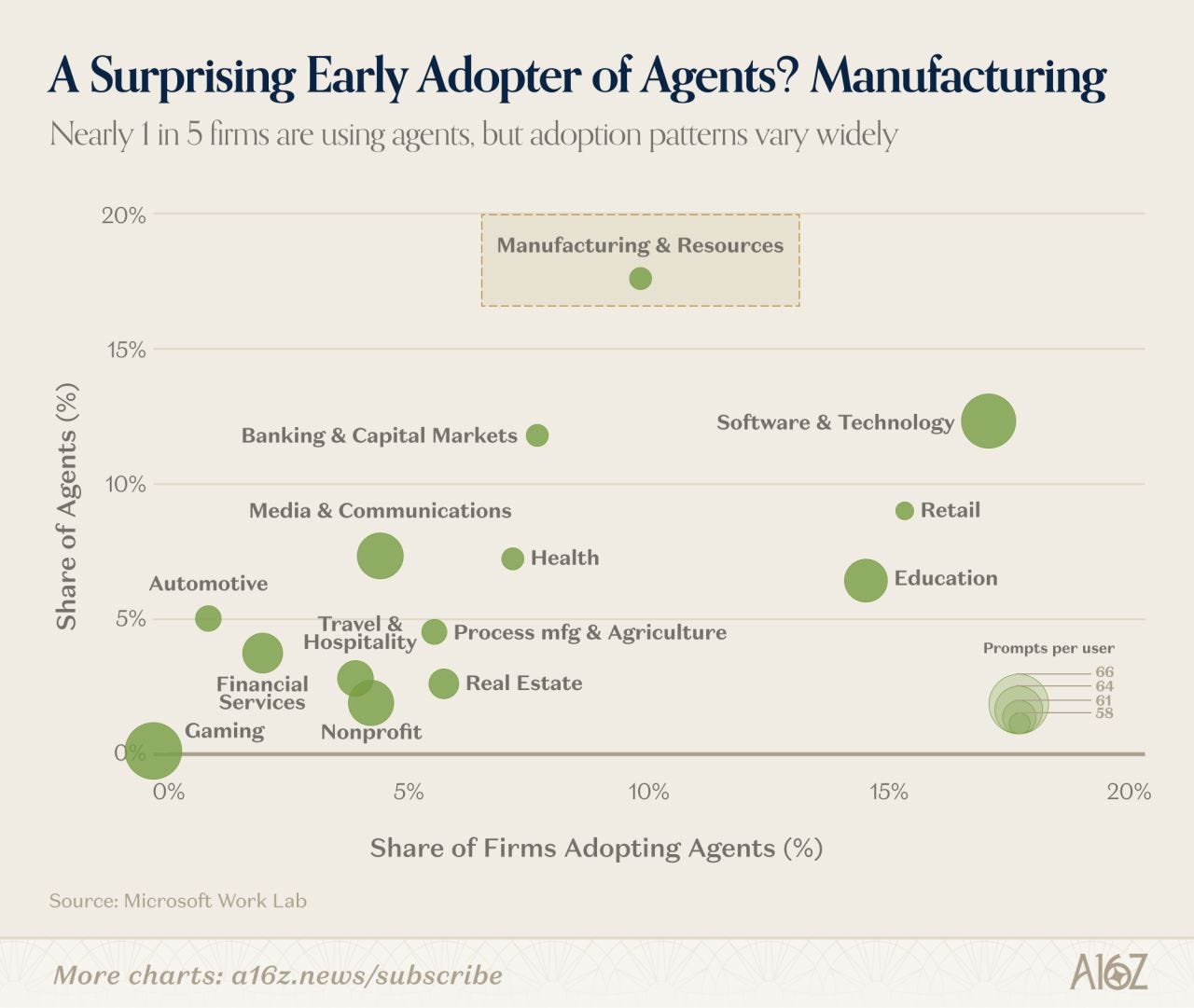
It plots 14 industries by two dimensions: how many firms in each sector are adopting AI agents, and what share of total AI usage those agents represent. The headline finding is counterintuitive — Manufacturing & Resources is the surprise early adopter, running more agent workflows than Software & Technology on a per-firm basis.
But that’s not what I found interesting.
What I found interesting is the question this chart doesn’t answer: while these companies race to adopt AI agents internally, are they tracking how AI is changing how their customers find them?
Because here’s the dynamic nobody is talking about. As businesses deploy AI agents to automate their workflows, their customers are simultaneously using AI — ChatGPT, Claude, Gemini, Perplexity — to research purchases, compare vendors, and make decisions. Two parallel AI revolutions are happening at once. Most companies are only paying attention to one of them.
This article walks through every industry on that chart and makes the case for what they’re missing — and how LLM Search Console gives each of them a concrete way to close the gap.
First: Why AI Agent Adoption and AI Search Visibility Are Connected
The Microsoft Work Lab data tells us that AI agents are spreading unevenly. Some industries are far ahead — Manufacturing, Software & Technology — while others like Gaming, Nonprofit, and Financial Services are just getting started.
But here’s the thread that ties every industry together: the customers of every one of these industries are already using AI search to make buying decisions.
In 2025, 29.2% of internet users make daily AI-assisted searches — up from 14% just seven months prior. These aren’t novelty queries. They’re the high-intent, category-defining questions that used to go to Google — and now increasingly go to an AI model.
The AI model answers them by referencing its training data, real-time web search, and the citations it has learned to trust. If your brand isn’t in those answers, you’re invisible — regardless of how sophisticated your internal agent stack is.
LLM Search Console tracks exactly this: how often your brand appears in AI-generated answers, with what sentiment, across which models and markets. Think of it as Google Search Console, but for the AI era.
Manufacturing & Resources: The Surprise Leader With a Hidden Exposure
Manufacturing & Resources sits at the top-left of the chart — the highest share of agents among all industries. These companies are operationally sophisticated with AI: predictive maintenance, supply chain optimization, quality inspection, and demand forecasting.
But who buys from manufacturers? Procurement managers and supply chain directors who are increasingly using AI search to find and shortlist vendors. When a procurement director asks Perplexity “which European precision machining suppliers are certified for IATF 16949?”, is your brand in that answer?
For manufacturing, LLM Search Console’s multi-market tracking is particularly valuable. A brand that appears in every ChatGPT answer in English may be entirely absent from Gemini answers in German.
Specific use case: A manufacturing company tracks 20 product-category prompts across 4 markets and discovers it’s well-cited in English-language ChatGPT responses but invisible in German Gemini queries — exactly the market where a major contract is up for renewal. They build a German-language technical content strategy and track the citation change over 90 days.
Software & Technology: The Most Contested AI Visibility Arena
Software & Technology sits in the high-adoption, high-agent-usage quadrant. When a startup founder asks ChatGPT “what’s the best CRM for a 10-person sales team?” the AI’s answer is effectively a category recommendation that will drive a free trial or a demo request.
In software, competitor analysis is where LLM Search Console earns its keep immediately. For a SaaS company, discovering that a direct competitor appears in 73% of AI responses to category queries while you appear in only 31% — and seeing which prompts drive that gap — is the difference between guessing and having a roadmap.
Specific use case: A B2B analytics platform finds that their competitor dominates “best analytics tool for e-commerce” prompts but is absent from “best analytics tool for subscription businesses” — a vertical they serve well. Three long-form guides later, their citation rate climbs measurably over the following quarter.
Banking & Capital Markets: High Stakes, Slow to Move, Fast to Lose
The customer side of banking is not moving carefully. Retail customers comparing savings accounts, SME owners looking for business loan providers, and wealth management prospects are all asking AI for recommendations.
For banking, sentiment tracking is critical. A bank dealing with reputational noise from a past regulatory issue may find that AI models consistently reference that noise when mentioning the brand, depressing conversion even when the brand is visible.
Specific use case: A digital bank discovers that while they appear in 60% of ChatGPT responses, sentiment is neutral-to-negative because a widely-cited article from 18 months ago mentions a discontinued fee. A targeted PR and content campaign corrects the narrative, with weekly sentiment recovery tracking.
Retail: High Adoption, the Highest Stakes
“Best running shoes for flat feet,” “most reliable espresso machine under €300,” “which luxury skincare brand is worth the price” — these are exactly the kind of queries where AI answers influence millions of purchase decisions.
For retail, prompt performance is the key LLM Search Console feature. A beauty brand might appear in 80% of responses to “best moisturiser for dry skin” but zero responses to “best moisturiser for mature skin” — a high-intent, premium demographic query.
Specific use case: A sportswear retailer discovers they dominate running-shoe prompts but are absent from “best trail running gear” queries. A comprehensive trail running guide seeded across specialist publications moves their citation rate from 0% to 34% within 60 days.
Media & Communications: The Industry That Should Know Better
Media companies understand distribution. They know that attention is finite and that the platforms controlling distribution control everything. AI search is a new distribution layer — and it is already directing enormous amounts of attention to the sources it trusts and cites.
For a media company, citations found is the most strategic LLM Search Console feature. Understanding which sources the AI trusts as citations for your brand tells you exactly where to invest in earned media and press strategy.
Specific use case: A digital media company discovers that three specific industry analysts and two academic institutions are cited disproportionately in AI responses about their brand. Building relationships with those analysts drives a 22-point AI visibility score improvement in one quarter.
Health: Where Visibility Can Change Lives
Patients research symptoms, compare clinics, look for second opinions, and evaluate treatment options using AI. The AI’s answer is shaping referral patterns.
For health organisations, multi-model coverage is essential. A hospital might appear prominently in Claude’s answers but be absent from Gemini’s — and different patient demographics use different AI tools.
Specific use case: A private oncology clinic discovers Claude recommends them consistently but Gemini defaults to a competitor. Gemini’s citation gap traces to academic publication absence — addressed by publishing a clinical outcomes report in a peer-reviewed journal.
Education: The Recommendation Economy

When prospective students ask “which university has the best computer science programme for international students?” or “what are the top MBA programmes in Europe for finance?”, they’re getting answers shaped by AI visibility.
For education, visibility trends over time are particularly valuable. Admissions cycles are annual — being able to plan content calendars around admissions peak periods is a capability traditional analytics can’t provide.
Specific use case: A business school finds their AI visibility peaks in autumn but drops in spring — exactly when prospective students are narrowing their shortlists. An always-on content strategy maintains year-round AI visibility and improves application quality.
Automotive: Complex Sales, Long Research Cycles, High AI Influence
Buying a car is a months-long decision. Buyers research extensively — comparing models, reading long-form reviews, asking specific questions about reliability, total cost of ownership, and resale value. AI models answer these queries in detail, citing specific publications and datasets.
Specific use case: A European EV brand finds that a rival dominates “most reliable electric family car” prompts. Citation analysis reveals the advantage comes from two highly-cited independent reliability reports. A commissioned user satisfaction study, placed in authoritative publications, begins shifting the citation pattern.
Travel & Hospitality: Where Recommendations Are Everything

TripAdvisor, Google Reviews, Booking.com — travel brands have always competed on platform visibility. AI search is the next recommendation layer. “Best boutique hotels in Porto,” “most reliable airlines for business travel in Europe” — these queries increasingly replace the first page of Google results for high-intent travel research.
For travel, geographic market tracking is the core use case. A hotel group in Lisbon needs to be visible in AI answers across the UK, Germany, France, Brazil, and the US — each with different prevalent AI models.
Specific use case: A boutique hotel group discovers near-zero visibility in Brazilian Gemini results — despite Brazil being their third-largest booking market. A Portuguese-language content strategy for Brazilian travel publications moves visibility from 5% to 41% within three months.
Process Manufacturing & Agriculture: B2B Buying Goes AI-First

B2B procurement is changing faster than most B2B marketers realise. Procurement managers are using AI to generate shortlists, validate vendor claims, and identify alternatives. For these industries, prompt performance analysis reveals the specific technical queries buyers are using — often far more granular than marketing teams assume.
Specific use case: An agricultural input supplier finds strong visibility for broad queries but zero visibility for specific queries around their premium biological product line — exactly the line with the highest margin. A targeted technical content campaign is built around those specific prompts.
Real Estate: The Research-Heavy Category
Buyers ask AI for neighbourhood comparisons, investment yield estimates, and agency recommendations. “Which real estate agency in Lisbon specialises in investment properties for foreign buyers?” shapes first calls. For real estate, visibility trends over time are particularly valuable because the market is cyclical.
Financial Services: The Underinvested Opportunity
Financial services firms that move early on AI search visibility will capture the kind of first-mover advantage that early SEO movers captured in the 2000s. Citations found reveals the trust infrastructure that needs to be built — which comparison sites, journalism outlets, and regulatory publications the AI cites when recommending financial products.
Gaming: Early Stage, Fast Growth Potential

The gaming community is one of the most AI-search-intensive demographics in the world. Gamers research game comparisons, hardware recommendations, and platform choices using AI daily. The opportunity is significant precisely because so few gaming brands are tracking AI visibility yet — building citation authority now creates a moat that compounds as AI search adoption grows.
Nonprofit: The Case for AI Visibility Without a Budget
When a potential donor asks ChatGPT “which environmental NGOs are most effective at combating deforestation in the Amazon?”, the AI’s answer shapes donation decisions. LLM Search Console’s free plan — 2 projects, 5 prompts, 50 scans per month — gives nonprofits a starting point with no financial commitment.
The Unifying Insight
Looking across all 14 industries on the Microsoft Work Lab chart, the pattern is clear: every sector that is adopting AI agents internally is simultaneously facing a customer-facing AI search challenge externally. The two are not the same problem — and solving one does not solve the other.
LLM Search Console exists for the customer-facing challenge. It tells you what AI models say about your brand, how often, with what sentiment, in which markets, and why — by revealing the citation sources driving each recommendation.
The brands that win the next five years will be the ones that treat AI search visibility the same way they treated Google search visibility in 2005: as a structural, compounding advantage worth building systematically, not as an afterthought.
Ready to see where your brand stands in every AI response? Start free at llmsearchconsole.com — no credit card required.
Source: Microsoft Work Lab AI Adoption Index via a0z.news.