

Welcome back to the LLM Search Console Blog.
For the last two decades, digital marketing lived and died by the static keyword. We obsessed over short, fragmented phrases like “best B2B CRM” or “top SEO agency.”
But search has fundamentally transformed. Buyers are completely bypassing traditional search boxes and migrating to answer engines like ChatGPT, Claude, and Perplexity. More importantly, they aren’t typing keywords anymore—they are using highly sophisticated, multi-layered prompts as their search terms.
If you want your brand to be visible in AI-generated answers, you have to understand exactly how power-users are constructing these queries.
Deconstructing the “Search Query” of the Future
To understand what we are up against, look at the file:
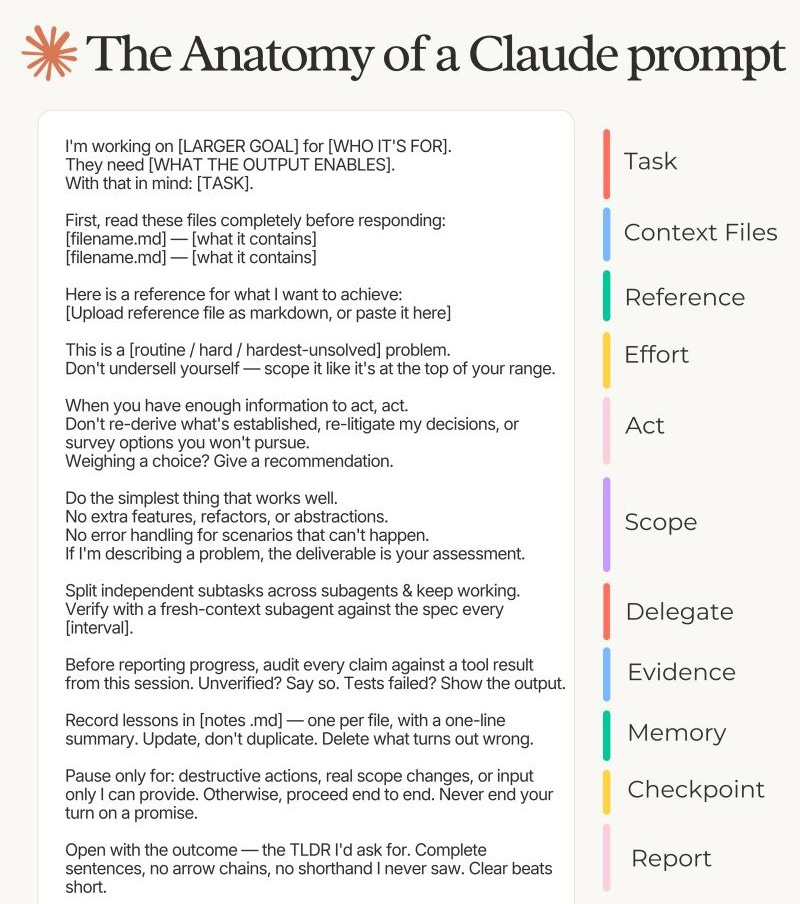
This brilliant infographic, “The Anatomy of a Claude prompt” by Ruben Hassid, outlines a highly detailed, agentic prompt framework. While engineered to get the absolute best performance out of an LLM, this blueprint is actually a goldmine for modern marketers. It reveals the exact anatomy of a high-intent buyer’s search process.
THE ANATOMY OF A MODERN LLM QUERY ┌─────────────────────────────────────────────────────────────────── TASK ──► CONTEXT FILES ──► REFERENCE ──► SCOPE ──► EVIDENCE ──► REPORT
└────────────────────────────────────────────────────────────────────
When a prospective client inputs a mega-prompt like the one in image_1de3f5.jpg to find a software solution or an agency, they aren’t just looking for random links. They are building an entire ecosystem for the AI to analyze:
Task & Context Files: The user anchors the AI with deep background information (“I’m working on [LARGER GOAL]... read these files completely before responding”).
Reference & Scope: They supply exact benchmarks of what they want to achieve and set hard constraints (“Do the simplest thing that works well... No extra features”).
Evidence & Report: They demand strict proof (“Audit every claim against a tool result... Unverified? Say so”), concluding with a hyper-specific formatting layout for the final answer.
Why This Matters for Brand Visibility
When a user deploys a prompt structure like this, the LLM becomes an exclusive gatekeeper. If your brand’s digital footprint isn’t optimized to feed into these specific prompt constraints, you are completely invisible.
To win a share of voice inside these conversational ecosystems, your website content needs to be highly extractable and verifiable so that when an LLM is ordered to “audit every claim,” your brand safely passes the test.
Best Tips to Create (and Optimize for) High-Intent Prompts
To successfully track and optimize your brand visibility using an LLM Search Console, you need to reverse-engineer how users query these models. Here are the best tips to build, test, and optimize prompts that mirror real user behavior:
1. Shift from Keywords to Persona Modifiers
Stop tracking single-word strings. Instead, mirror the Task block from image_1de3f5.jpg by injecting real-world constraints into your tracking queries.
Instead of tracking: “Accounting software”
Track this prompt: “I am a freelancer with international clients looking for an accounting software that handles multi-currency invoicing without complex abstractions.”
2. Trigger the “Evidence” Layer
Notice how image_1de3f5.jpg explicitly commands the AI to “audit every claim.” When testing your brand’s visibility baseline, always force the AI to cite its sources. This tells you exactly which third-party directories, Reddit subreddits, or review platforms are feeding the LLM its information about you.
3. Build Content for “Extractability”
If users tell AI to “do the simplest thing that works well” and demand a tight, clear “Report,” the LLM will favor web content that it can scrape without friction.
Answer immediately: Place direct answers right under your H2 headings.
Use structured formats: Use tables, bullet points, and clean lists. LLMs love structured data because it can easily be lifted and dropped into the user’s requested output layout.
Keep a clean technical structure: Implement an
llms.txtfile and clear Organization schema to make it easy for AI crawlers to verify your brand’s entity.
The Bottom Line
The brands winning the AI era aren’t necessarily the ones ranking #1 on page one of traditional search engines. The winners are the ones whose content is structured well enough to survive the rigorous filtering of a 10-part Claude prompt.
How are you currently adapting your content strategy to ensure LLMs can easily extract your brand as “Evidence” during complex user prompts?