

Most GEO advice still assumes AI engines work like a 2023 RAG demo: embed the query, pull the top-k nearest chunks, stuff them into one prompt, generate. Write "semantically rich" content, the theory goes, and the cosine similarity will find you. That mental model is legacy. Production answer engines run hybrid retrieval, rerank, fan out queries, and ground on whatever survives. If you still optimise for a single embedding lookup, you are optimising for a pipeline nobody runs anymore.
Here are three connections between vector-only RAG, single-shot prompting, and brand visibility that rarely get discussed, and what to do about each. Track the results with LLM Search Console instead of guessing.
1. Embeddings blur proper nouns, so you get swapped for a competitor
Dense embeddings are good at meaning and bad at identity. "Acme CRM for agencies" and "Globex CRM for agencies" land almost on top of each other in vector space. The brand token is a rounding error next to the category semantics. A vector-only retriever will happily return your competitor's chunk for a query that named you.
This is why hybrid retrieval exists: a lexical pass (BM25 or similar) keeps exact tokens like brand names, SKUs, version numbers and plan names from dissolving into the category average. The implication for GEO: exact-match consistency matters again. If your product is "Acme CRM" on the homepage, "AcmeCRM" in docs and "Acme Platform" on G2, you split your lexical signal three ways and hand the dense side a fuzzy entity to confuse.
The symptom you will see in monitoring: an engine describes your feature set accurately but attributes it to someone else, or names you in a list with the wrong pricing tier. That is a retrieval identity failure, not a content quality problem.
2. Chunking orphans your brand from its own claims
Retrievers do not read pages. They read chunks, typically a few hundred tokens split on headings or length. Marketing copy loves pronouns and implied subjects: "It integrates with 40 tools. Our platform cuts setup time in half." Once that paragraph is chunked away from the H1, the entity is gone. The chunk says something integrates with 40 tools. The model cannot cite you for a claim that does not contain your name.
Call it chunk orphaning. It is the quiet reason brands with strong pages still get paraphrased instead of named. The fix is boring and effective: restate the entity inside every section that carries a claim worth citing. "Acme CRM integrates with 40 tools" survives any chunk boundary. "It integrates with 40 tools" does not.
3. Single-shot prompt tracking is the same mistake as single-shot prompting
Engineers dropped single-shot prompt engineering because one phrasing is a sample of one: brittle, non-reproducible, sensitive to wording. Yet many teams still measure AI visibility by typing one query into ChatGPT once and screenshotting the answer. That is single-shot measurement, and it inherits every flaw of single-shot prompting.
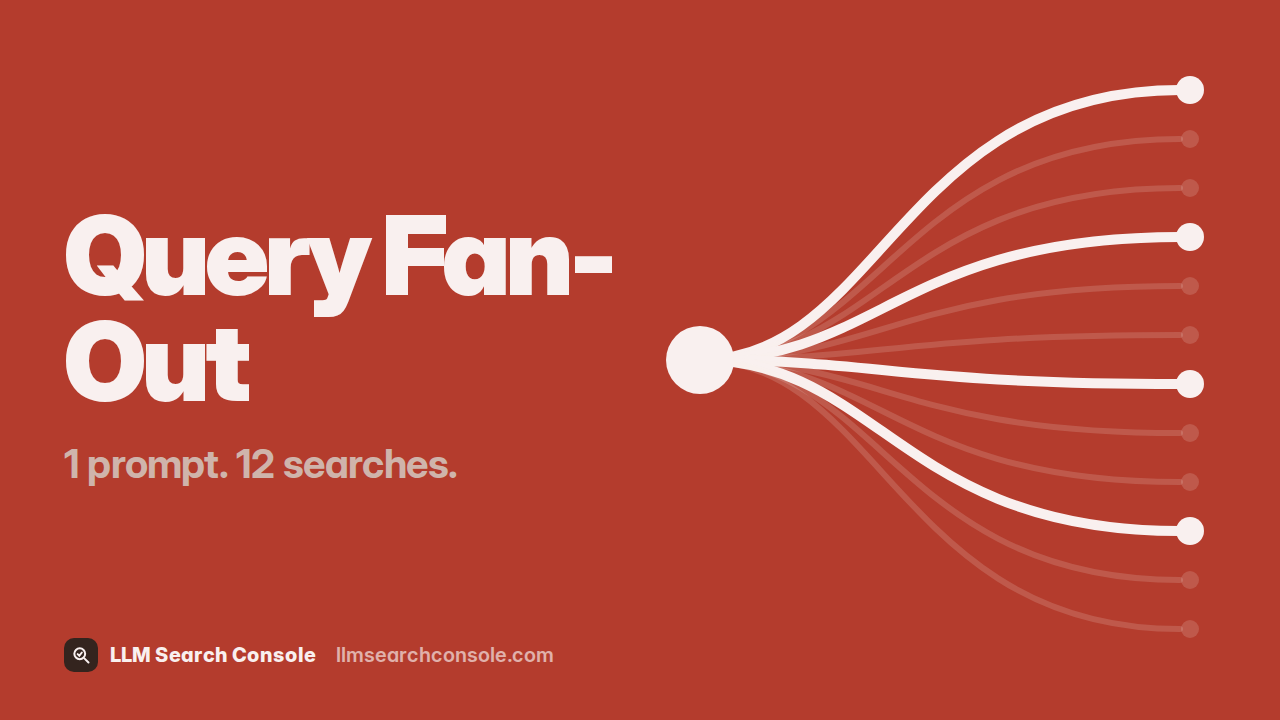
Modern engines decompose a prompt into several sub-queries (query fan-out), retrieve for each, and merge. Your brand might win the "best CRM for agencies" branch and lose the "CRM pricing comparison" branch that fires underneath it. One manual check cannot see that. You need the same prompt set run repeatedly across models, markets and phrasings, with visibility scored as a rate rather than a yes/no.
That is exactly what LLM Search Console does: scheduled scans across ChatGPT, Gemini, Perplexity, Claude, Google AI Overviews and AI Mode, a visibility score per prompt and per model, competitor gap analysis, and a full citation log showing which URLs and snippets each engine actually pulled. The citation log is the closest thing you get to seeing the retriever's output from the outside.
4. Why this matters more as engines get "smarter"
Reranking and grounding layers are getting stricter about verifiable, attributable passages. That raises the bar on the three failure modes above. An ambiguous entity loses at the lexical stage. An orphaned chunk loses at the grounding stage because it cannot support a named claim. And a brand measured with one-off screenshots never learns which stage it lost at. Hybrid retrieval did not make GEO easier. It made it more mechanical, which means it is fixable if you instrument it.
Quick wins for GEO
Lock one canonical brand string and product names across site, docs, schema, review sites and press. Treat variants as bugs.
De-orphan your claims: every H2 section with a stat, feature or price should name the brand explicitly.
Keep exact tokens in plain text: SKUs, plan names and prices in HTML, not only in images or JS-rendered tabs.
Write chunk-sized answers: self-contained 80 to 150 word blocks under question-style headings.
Track prompt sets, not prompts: 5 to 10 phrasings per intent, scanned on a schedule, per model and market.
Audit citations weekly: if an engine cites a competitor's page for your feature, you have an identity or orphaning problem.
Stop guessing which retrieval stage drops your brand. Start tracking with LLM Search Console, plans from 49€/month.