

Your Semrush dashboard says organic traffic is flat and rankings are stable. Meanwhile a prospect asked ChatGPT for the best vendors in your category, got five names, and your brand wasn't one of them. No tool in your current stack logged that moment.
That is the real gap between LLM visibility tools and SEO suites. One measures where your pages rank. The other measures whether models mention, cite and recommend you when buyers ask.
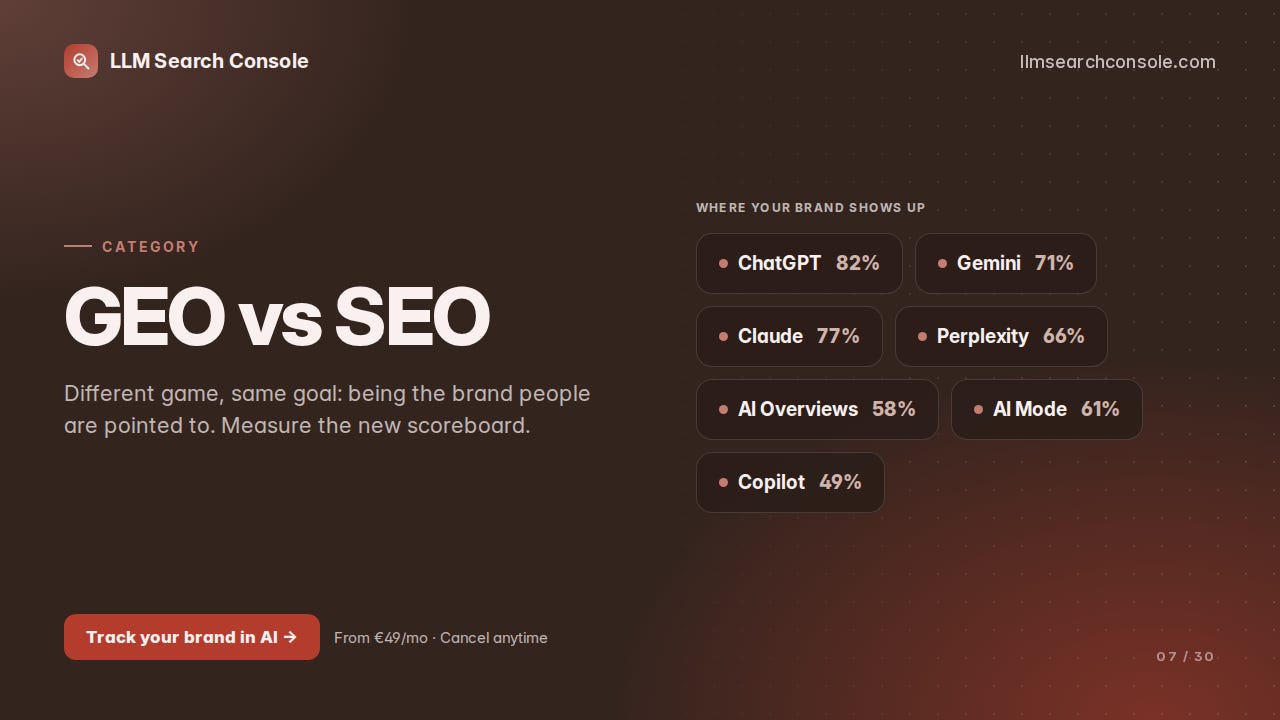
Most teams now face the same budget question. Do you add a dedicated tracker, wait for Semrush, Ahrefs or HubSpot to bolt on AI features, or do nothing and hope the rankings carry over? Here is a way to decide.
What an SEO suite actually measures
SEO suites were built around a ranked list of ten blue links. Everything in them assumes a keyword, a position, a click and a session.
That model still matters. Your pages feed the retrieval layer that many AI engines draw on. But the suite stops at the edge of the page. It can't tell you what a model said about you after it read the page.
Where the suites fall short
No view of the answer text itself
Prompts, not keywords, drive AI answers
Citations are tracked as an add-on, if at all
Answers change by run, so one snapshot proves nothing
What an AI visibility tool measures
A dedicated tool starts from the prompt. It runs a fixed set of buyer questions against ChatGPT, Gemini, Perplexity, Claude, Copilot and others, then records what each engine says. The output is mentions, citations, sentiment and share of voice against named competitors.
Because answers vary, the useful tools repeat each prompt several times and report a rate, not a single result. A brand that appears in 7 of 10 runs is in a different position than one that appeared once.
The numbers worth watching
Mention rate per prompt
Citation rate and which URLs get cited
Share of voice against three to five competitors
Sentiment of the sentence that names you
The comparison that actually helps
Stop asking which category is better. Ask which question each one answers.
An SEO suite answers whether your pages are findable and healthy. An AI visibility tool answers whether your brand survives the summary. Technical audits, backlink data and keyword research stay with the suite. Prompt tracking, citation sources and competitor share of voice go to the new layer.
The overlap is smaller than the vendors' feature pages suggest. Adding an "AI overview" tab to a rank tracker is not the same as running structured prompts across six engines and storing every answer.
A four-step way to decide
Step 1. Audit what your suite already reports
Open the AI features in your current plan. Check whether they show full answer text, which engines are covered, how often prompts run, and whether you can export the raw data. If the answer to most of those is no, you have a rank tracker with a label on it.
Step 2. Build a prompt set from your sales calls
Pull thirty questions your buyers really ask. Comparison questions, "best for" questions, and "alternatives to" questions. These are the prompts that decide shortlists.
Step 3. Run a two-week test
Track the same prompt set in your suite's AI module and in a dedicated tool. Compare coverage, repeatability and the quality of competitor data. The gap shows up fast.
Step 4. Cut the overlap
If the dedicated tool covers the answer layer, don't pay for a second AI add-on. Keep the suite for audits and links. Move the AI budget to the tool that stores answers.
Where the money goes wrong
Three mistakes show up again and again. Teams buy the bundle because procurement already approved it. Teams track brand terms only and miss the category prompts where buyers discover them. And teams review the dashboard monthly, which is far too slow for a surface that shifts weekly.
A fixed prompt set, a weekly review and one owner fixes most of it.
Run the test this week
You can settle the suite-versus-tracker question in one afternoon. Take your thirty prompts, run them across the engines your buyers use, and count how often you appear next to your two closest competitors. Then check whether your current stack could have told you that.
LLM Search Console tracks brand mentions, citations and share of voice across ChatGPT, Gemini, Perplexity, Claude, Copilot and DeepSeek from a single prompt set, so the comparison takes one view instead of a stack of exports.
Subscribe to the newsletter to get the next breakdown in your inbox. One AI visibility problem a week, with the data and the fix.